
24-P-001-1.0
Disclaimer Regarding Use of SWGDE Documents
SWGDE documents are developed by a consensus process that involves the best efforts of relevant subject matter experts, organizations, and input from other stakeholders to publish standards, requirements, best practices, guidelines, technical notes, positions, and considerations in the discipline of digital and multimedia forensics and related fields. No warranty or other representation as to SWGDE work product is made or intended.
SWGDE requests notification by email before or contemporaneous to the introduction of this document, or any portion thereof, as a marked exhibit offered for or moved into evidence in such proceeding. The notification should include: 1) The formal name of the proceeding, including docket number or similar identifier; 2) the name and location of the body conducting the hearing or proceeding; and 3) the name, mailing address (if available) and contact information of the party offering or moving the document into evidence. Subsequent to the use of this document in the proceeding please notify SWGDE as to the outcome of the matter. Notifications should be submitted via the SWGDE Notice of Use/Redistribution Form or sent to secretary@swgde.org.
From time to time, SWGDE documents may be revised, updated, deprecated, or sunsetted. Readers are advised to verify on the SWGDE website (https://v8g6l3d3148.c.updraftclone.com) they are utilizing the current version of this document. Prior versions of SWGDE documents are archived and available on the SWGDE website.
Redistribution Policy
SWGDE grants permission for redistribution and use of all publicly posted documents created by SWGDE, provided that the following conditions are met:
- Redistribution of documents or parts of documents must retain this SWGDE cover page containing the Disclaimer Regarding Use.
- Neither the name of SWGDE nor the names of contributors may be used to endorse or promote products derived from its documents.
- Any reference or quote from a SWGDE document must include the version number (or creation date) of the document and also indicate if the document is in a draft status.
Requests for Modification
SWGDE encourages stakeholder participation in the preparation of documents. Suggestions for modifications are welcome and must be submitted via the SWGDE Request for Modification Form or forwarded to the Secretary in writing at secretary@swgde.org. The following information is required as a part of any suggested modification:
- Submitter’s name
- Affiliation (agency/organization)
- Address
- Telephone number and email address
- SWGDE Document title and version number
- Change from (note document section number)
- Change to (provide suggested text where appropriate; comments not including suggested text will not be considered)
- Basis for suggested modification
Intellectual Property
All images, tables, and figures in SWGDE documents are developed and owned by SWGDE, unless otherwise credited.
Unauthorized use of the SWGDE logo or document content, including images, tables, and figures, without written permission from SWGDE is a violation of our intellectual property rights.
Individuals may not misstate and/or over represent duties and responsibilities of SWGDE work. This includes claiming oneself as a contributing member without actively participating in SWGDE meetings; claiming oneself as an officer of SWGDE without serving as such; claiming sole authorship of a document; use the SWGDE logo on any material and/or curriculum vitae.
Any mention of specific products within SWGDE documents is for informational purposes only; it does not imply a recommendation or endorsement by SWGDE.
1. Purpose
2. Scope
3. Equipment
Please reference SWGDE Photographic Equipment and Infrastructure Recommendations before the implementation of new equipment or procedures.
- Digital Single Lens Reflex or Mirrorless Interchangeable Lens Camera
- Dedicated Macro Lens
- Tripod or Copy stand
- Shutter Release Cable or Remote
- Forensic scales or other visual measurement reference
- Angle Finder or Digital Inclinometer
- Focus Rail
4. Camera Settings and Techniques
In macro photography, margins for error in getting a properly exposed and focused image are reduced. Taking that into consideration with capturing the highest quality images possible, the following camera settings and techniques are recommended.
- Verify camera settings including, but not limited to: time/date, image file format, and image size. Images should be captured uncompressed, or using lossless compression (e.g. RAW or TIFF). Refer to SWGDE Digital Image Compression and File Formats Guidelines.
- Use the lowest native ISO of the camera sensor.
- Deactivate image stabilization.
- Use the Manual or Aperture Priority modes to have more control over the exposure and depth of field.
- Select the correct white balance for the lighting conditions, or use the custom white balance function to ensure accurate color reproduction.
- The scale should be oriented along the long edge of the frame whenever possible.
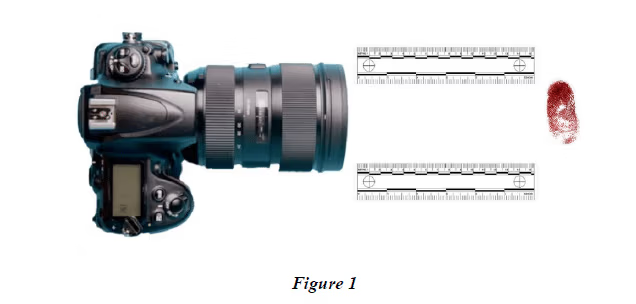
- Position the camera so that the sensor plane is parallel to the subject; using an angle finder/inclinometer can be beneficial. Measuring from both sides of the lens to the subject can also help ensure that the sensor plane is parallel.
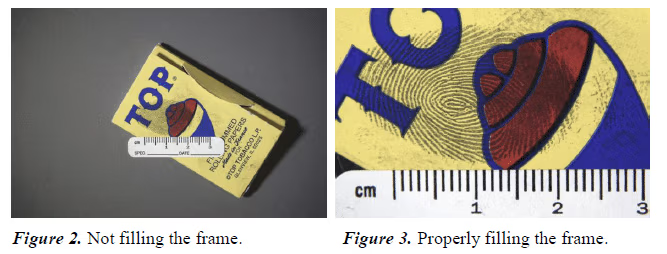
- Choose the correct orientation to best fit the subject to be photographed by filling the frame.
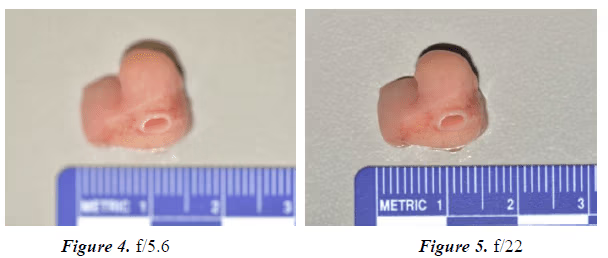
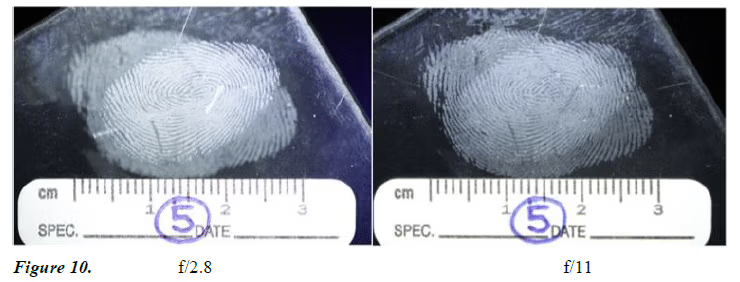
- Select an f/stop that ensures sufficient depth of field without introducing diffraction. Keep in mind that depth of field in macro photography is severely limited.
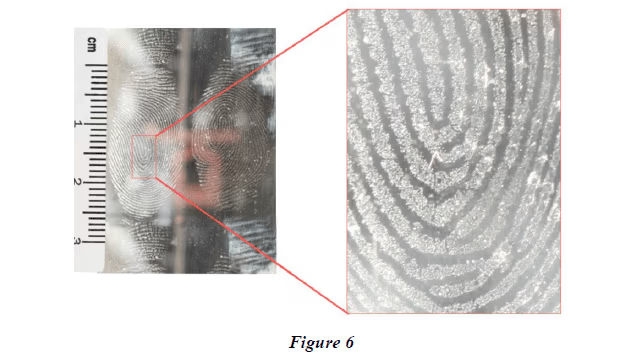
- Ensure critical focus is set on the intended area of interest. Zooming in while using live view or after the photo is taken may be used to verify critical focus.
5. Considerations
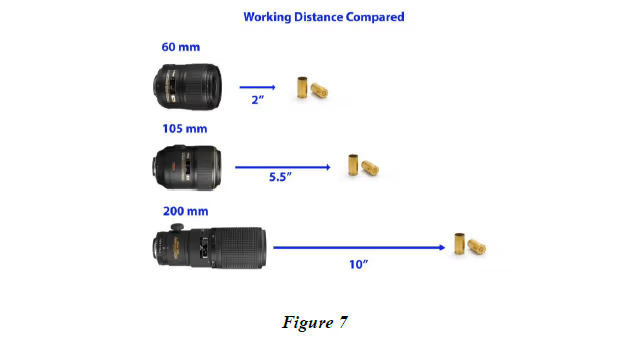
- Working distance is the distance from the subject to the front of the lens. It is greatly reduced when taking macro photographs. This distance can be increased by increasing the focal length of the lens. This may be advantageous, allowing more space to access the object and adjust lighting.
- Lighting setups may vary greatly from subject to subject. Depending on the properties of the item being photographed, the distance between the front of the lens and the subject, and the details you are trying to capture, the position and the angle of the light(s) should be carefully considered, and multiple setups may need to be attempted before achieving the desired result. Refer to SWGDE Lighting Techniques in Forensic Photography v.1.0
- The depth of field may be millimeters or less with macro photography. When details like fingerprints are on curved surfaces, set the point of focus halfway between the closest and furthest points of detail.

- The effects of motion will become exaggerated when taking macro photographs, therefore a stable mount such as a tripod or copy stand should be used in addition to a remote shutter release. If the effects of motion are still perceived in the images, a faster shutter speed and more light may be necessary.
- Whenever possible, evidence should be photographed on a neutral background.
- Scales should be placed on the same plane as the item being documented. If it is not possible to include a scale with the item, a separate image of just a scale should be taken at the same focal distance.
- Bracketing exposures will ensure details are captured in the highlights and shadows.
- Choosing a shallower depth of field can aid in visualizing evidence on transparent surfaces with a distracting background or trace materials on the opposing side.
6. Special Techniques
- Focus Stacking is a technique of taking multiple photographs of the same subject at different focus points from the closest to the farthest point of detail and blending those images to create one composite image with an increased depth of field. Several software applications are available for this purpose.
- Focusing rails allow for the minute adjustment of camera position and are very helpful in macro photography. They may also be necessary to make the incremental adjustments required to create a series of images for focus stacking.
- The use of a bellows or extension tube will move the lens further from the sensor thereby increasing magnification.
7. References
- SWGDE 16-P-001-2.0 Photographic Equipment and Infrastructure Recommendations
- 2022-06-09 SWGDE Lighting Techniques in Forensic Photography v.1.0
8. History
| Revision | Issue Date | History |
|---|---|---|
|
1.0 DRAFT |
1/9/2024 |
Initial draft created and moved forward for SWGDE vote to release as a Draft for Public Comment. |
|
1.0 DRAFT |
3/1/2024 |
Formatted for posting after SWGDE membership voted to release as a Draft for Public Comment. |
|
1.0 |
5/16/2024 |
No public comments received. Moved forward for SWGDE membership vote to release as a Final Approved Document. |
|
1.0 |
8/2/2024 |
SWGDE voted to approve as a Final Approved Document. Formatted for release as a Final Approved Document. |
Version: 1.0 (8/5/2024)