
20-f-001
Disclaimer:
As a condition to the use of this document and the information contained therein, the SWGDE requests notification by e-mail before or contemporaneous to the introduction of this document, or any portion thereof, as a marked exhibit offered for or moved into evidence in any judicial, administrative, legislative or adjudicatory hearing or other proceeding (including discovery proceedings) in the United States or any Foreign country. Such notification shall include: 1) the formal name of the proceeding, including docket number or similar identifier; 2) the name and location of the body conducting the hearing or proceeding; 3) subsequent to the use of this document in a formal proceeding please notify SWGDE as to its use and outcome; 4) the name, mailing address (if available) and contact information of the party offering or moving the document into evidence. Notifications should be sent to secretary@swgde.org.
It is the reader’s responsibility to ensure they have the most current version of this document. It is recommended that previous versions be archived.
Redistribution Policy:
SWGDE grants permission for redistribution and use of all publicly posted documents created by SWGDE, provided that the following conditions are met:
- Redistribution of documents or parts of documents must retain the SWGDE cover page containing the disclaimer.
- Neither the name of SWGDE nor the names of contributors may be used to endorse or promote products derived from its documents.
- Any reference or quote from a SWGDE document must include the version number (or create date) of the document and mention if the document is in a draft status.
Requests for Modification:
SWGDE encourages stakeholder participation in the preparation of documents. Suggestions for modifications are welcome and must be forwarded to the Secretary in writing at secretary@swgde.org. The following information is required as a part of the response:
- Submitter’s name
- Affiliation (agency/organization)
- Address
- Telephone number and email address
- Document title and version number
- Change from (note document section number)
- Change to (provide suggested text where appropriate; comments not including suggested text will not be considered)
- Basis for change
Intellectual Property:
Unauthorized use of the SWGDE logo or documents without written permission from SWGDE is a violation of our intellectual property rights.
Individuals may not misstate or over represent duties and responsibilities of SWGDE work. This includes claiming oneself as a contributing member without actively participating in SWGDE meetings; claiming oneself as an officer of SWGDE without serving as such; claiming sole authorship of a document; use the SWGDE logo on any material or curriculum vitae.
Any mention of specific products within SWGDE documents is for informational purposes only; it does not imply a recommendation or endorsement by SWGDE.
Table of Figures
Figure 1– Process map
Figure 2 – 8-bit hex and ASCII
Figure 3 – Carving with Strings
Figure 4 – View 5-bit as Binary
Figure 5 – 5-bit in editor
Figure 6 – Formatting 5-bit
Figure 7 – 5-bit stream
Figure 8 – 5-bit reversed
Figure 9 – Binary decimal
Figure 10 – Cipher text
Figure 11 – Deciphered text
Figure 12 – Cipher text, correct nibbles
Figure 13 – De-ciphered text, correct nibbles
Figure 14 – De-ciphered text, incorrect second nibble
Figure 15 – Ciphered skimmer example
Figure 16 – Non-continuous key application
Figure 17 – Microcontroller contents
Figure 18 – Multi-byte key cipher text
1. Purpose
Skimmers are magnetic card readers used to capture account information. Able to be implanted into or overlaid onto a device or carried on a person, skimmers collect personal (typically banking) information in an unauthorized manner. The purpose of this test method is to provide specific procedures required to analyze data contained on digital skimming devices.
2. Scope
This document is intended for computer forensic practitioners conducting forensic analysis on skimming devices using a digital storage format. It does not provide best practices regarding skimmer examinations, chip/SD card extractions, analog skimmer analysis, Bluetooth® module extraction / analysis, or device repair as that data is available, at a minimum, in the following publications:
- SWGDE Best Practices for Examining Magnet Card Readers;
- ASTM E3017-19 Standard Practice for Examining Magnetic Card Readers;
- SWGDE Best Practices for Chip Off;
- SWGDE Best Practices for Computer Forensics Acquisitions;
- SWGDE Test Method for Skimmer Analysis – Analog Devices;
- SWGDE Test Method for Bluetooth Module Extractions and Analysis; and
- SWGDE Embedded Device Core Competencies.
3 Limitations
Skimmers present unique examination challenges due to:
- Rapid changes in technology;
- Countermeasures;
- Multiple data encoding/ciphering formats; and
- Lack of commercially available software to analyze data extracted from skimmers.
4 Process Map
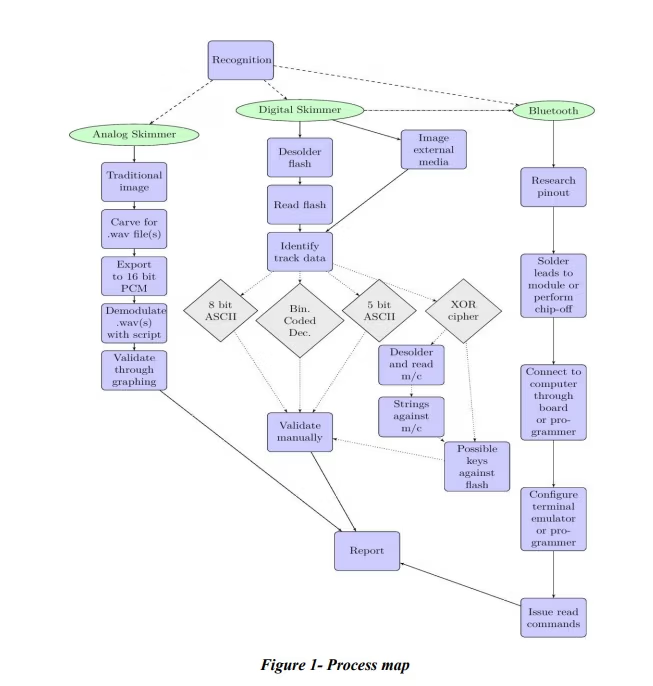
As an overview, the following map depicts the complete process for examining a skimming device to include any wireless components used for the exfiltration of data. This document focuses on the digital skimmer column, post imaging.
5 Analysis – Digital Skimmer
5.1 8-bit ASCII
The following is the process to analyze a skimmer that is storing account data in an 8-bit ASCII format:
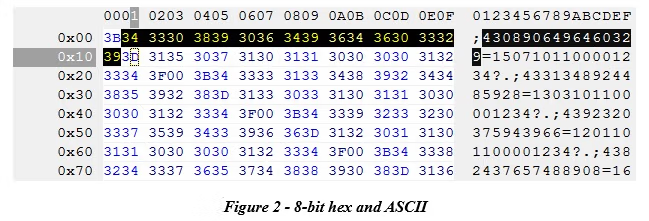
- The majority of hex viewers have the ability to display data by default in both base 16 hexadecimal and 8-bit ASCII formats. A skimmer designed to store account information in 8-bit ASCII makes data identification simple, e.g. 4308906496460329
- Below, one can see that a primary account number is highlighted between 3B and 3D in hex or; and = on the ASCII side:
5.1.1 Carve the account numbersby runningStrings againstthe file, i.e., strings filename.bin.
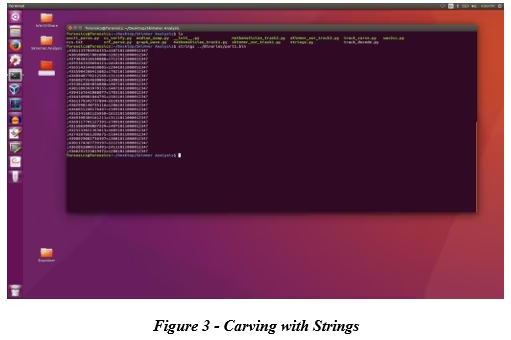
- One can send the output to a text file by adding the “>” and a filename to the argument, e.g. “strings filename.bin > resultsfilename.txt”
- In addition to account data, Strings will also display other track data, e.g. account holder names if the skimmer was capturing and recording track 1 data (for skimmers using 8-bit ASCII)
5.1.2 Validate the Strings carving by viewing the file in a hex editor and matching at least one of the numbers from the output to a number present in the 8-bit ASCII view of the hex editor, running any possible account numbers against the Luhn algorithm.
Using the number displayed above: 4308906496460329
8 3 0 8 9 0 3 4 9 6 8 6 0 3 4 9 = 80 = valid
8 0 18 12 18 8 0 4
4 3 0 8 9 0 6 4 9 6 4 6 0 3 2 9
5.2 5-bit Binary
Another encoding scheme used with skimmers is 5-bit binary. The process to analyze skimmers encoded in this format is as follows:
5.2.1 In order to view and export image data in binary form, from an UbuntuLinuxterminal window, run:
xxd -b -c 256 part3.bin > ../test.txt
(this command will write the binary data to a file without column breaks in a file one directory higher then where the bin file resides);
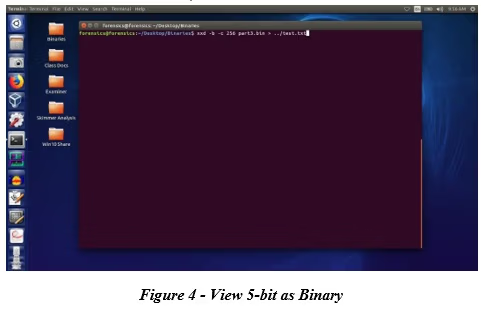
5.2.2 Open in an editor (Gedit is shown here) by double clicking on the new file;
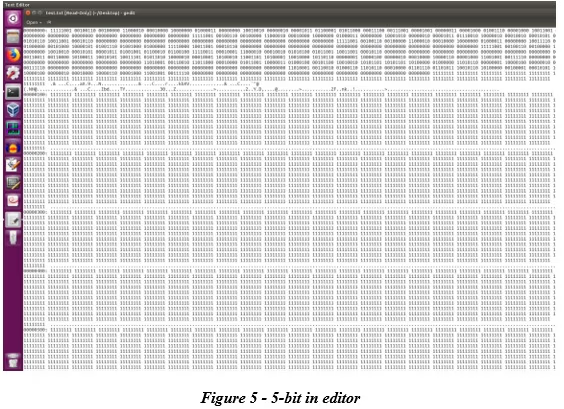
5.2.3 Use the search/replace function of the editor to remove spaces; i.e. search for ” “, replace with (leave blank)
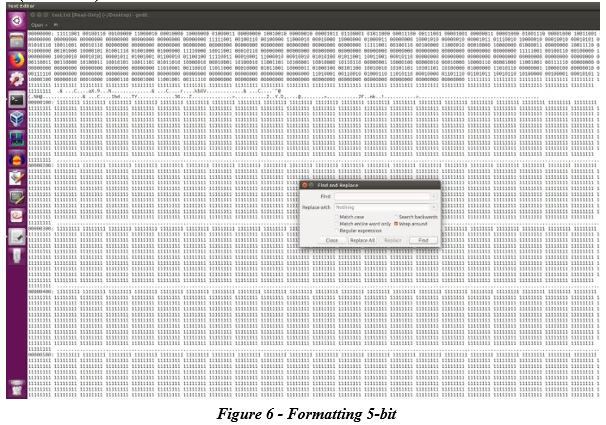
5.2.4 Locate 5-bit binary start sentinels (right to left and left to right for reverse swipes) and manually decode the following (or preceding) bits according to 5-bit binary, running any possible account numbers against the Luhn algorithm;
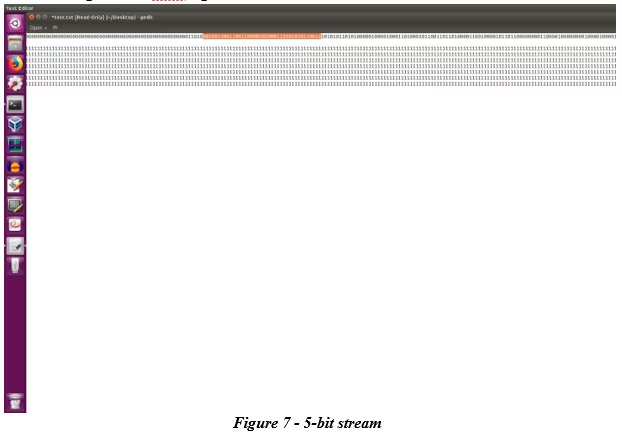
- Bit stream from above:
00100110011001100001010001110010101100111010101101010000010000100011010001011001
0010|0 – 4
1100|1 – 3
1001|1 – 9
0000|1 – 0
0100|0 – 2
1110|0 – 7
1010|1 – 5
1001|1 – 9
1010|1 – 5
0110|1 – 6
0100|0 – 2
0010|0 – 4
0010|0 – 4
0110|1 – 6
0001|0 – 8
1100|1 – 3
4390 2759 5624 4683
Luhn:
8 3 9 0 4 7 1 9 1 6 4 4 8 6 7 3 = 80 = Valid
8 18 4 10 10 4 8 16
4 3 9 0 2 7 5 9 5 6 2 4 4 6 8 3
5.3 Additional 5-bit encoding
There are other ways in which 5-bit binary encoding can be implemented. In the previous example, the recovered account number was encoded as a forward swipe, 5-bit binary; however, there are more encoding options within 5-bit binary, one of which is bit-order in byte reverse endian. The following is the process to analyze 5-bit binary bit-order in byte reverse endian encoding:
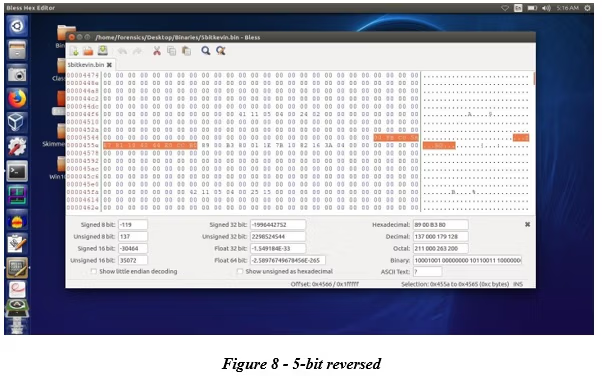
5.3.1 Identify possible account data. One can see from the above image, there appears to be a repeated 7 byte header followed eventually by what may be track data;
5.3.2 Copy base 16 hexadecimal values for what appears to be track data;
- Note: at this point one would not know exactly how many bytes to copy. As such, copying 11 bytes is a good starting point and as the decoding process continues, more/less bytes may be required.
- From the above file: 0x 8b c0 5a e7 81 10 42 44 e0 cc b0
5.3.3 Translate from hexadecimal to binary:
- 0x8B – 1000 1011
- 0xC0 – 1100 0000
- 0x5A – 0101 1010
- 0xE7 – 1110 0111
- 0x81 – 1000 0001
- 0x10 – 0001 0000
- 0x42 – 0100 0010
- 0x44 – 0100 0100
- 0xE0 – 1110 0000
- 0xCC – 1100 1100
- 0xB0 – 1011 0000
- Combined as a single binary string: 1000101111000000010110101110011110000001000100000100001001000100111000001100110010110000
- One can immediately recognize with all the repeated zeros and the lack of proper 5-bit parity, a different process is required
5.3.4 Separate the binary string into 8-bit chunks, then perform the reversal operation:
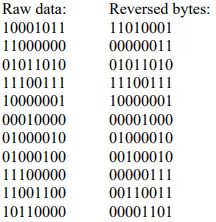
- Reversed values from above:
11010001 00000011 01011010 11100111 10000001 00001000 01000010 00100010 00000111 00110011 00001101
5.3.5 Remove the spaces:
1101000100000011010110101110011110000001000010000100001000100010000001110011001100001101
5.3.6 Separate into 5-bit chunks:
11010 00100 00001 10101 10101 11001 11100 00001 00001 00001 00001 00010 00100 00001 11001 10011 00001 101
5.3.7 Decode the little endian* 5-bit binary to an account number
- 11010 – Start Sentinel (it is now known the decoding started at a correct byte)
00100 – 4 - 00001 – 0
- 10101 – 5
- 10101 – 5
- 11001 – 3
- 11100 – 7
- 00001 – 0
- 00001 – 0
- 00001 – 0
- 00001 – 0
- 00010 – 8
- 00100 – 4
- 00001 – 0
- 11001 – 3
- 10011 – 9
- 00001 – 0
- 101 <== Cut-off field separator
The 5-bit binary, reverse endian bit order in bytes, value is 4055 3700 0084 0390.
* Note: when working the decoding, it will not be immediately apparent if the data is big endian or little endian. One would work both until a valid account number is resolved. It is seen from above that little endian resolved the account number correctly.
5.3.8 Luhn validation
8 0 1 5 6 7 0 0 0 0 7 4 0 3 9 0 = 50 = valid
8 10 6 0 0 16 0 18
4 0 5 5 3 7 0 0 0 0 8 4 0 3 9 0
5.4 Binary Decimal
5.4.1 Binary Decimal is a non-ASCII encoding. The second nibble of a range of bytes represents a digit in the account number.
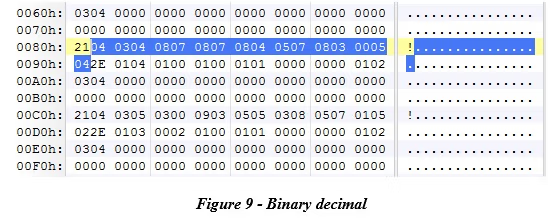
- Note in the above image, there is a hexadecimal header that equals 0x21, after which the account number immediately begins. The account number highlighted above is 4348 7878 4578 3054
5.4.2 Luhn validation
8 3 8 8 5 8 5 8 8 5 5 8 6 0 1 4 = 90 = valid
8 8 14 14 8 14 6 10
4 3 4 8 7 8 7 8 4 5 7 8 3 0 5 4
5.5 Encoded Skimmer Scripting
Whether seeking to automate the above digital encoding analysis tasks one may turn to scripting solutions. Scripts can take advantage of certain knowns about digital encoding formats plus the knowledge of the format of valid account data, e.g. valid account numbers must resolve to the Luhn algorithm. For Python 2.7 based decoding scripts See Appendix 1.
5.6 XOR Ciphers
5.6.1 XOR Basics
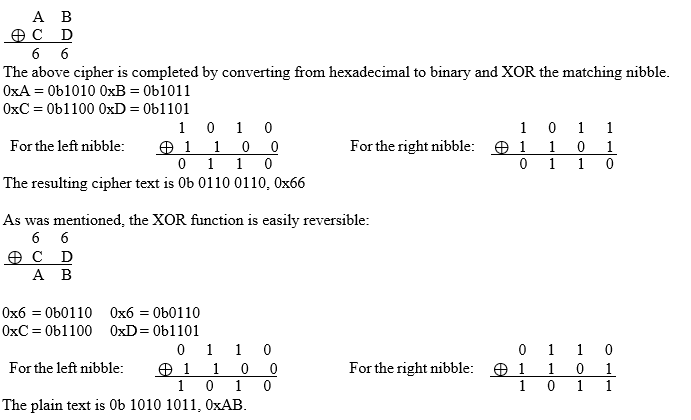
XOR cipher is defined as a simple repeated-key. An XOR cipher applies a key to a message to produce a cipher text:
plain text ⊕ key = cipher text
XOR functions in a way that if any two values are known, the third can be solved, e.g.:
cipher text ⊕ key = plain text
plain text ⊕ cipher text = key
In simple form, data may be XOR ciphered using a one byte hexadecimal key, for example:
5.6.2 XOR In Practice
The following is offered to show how one may test logical guesses in order to determine a key. USSS Tulsa Cell Phone Laboratory challenge coin
Example cipher text: 0x8B EB EB EB EA 88 18 18 DB 58
28 38 88 BA 28 F9 88 38 E9 48
E8 BA C8 E8 48 18 48 99 49 7A
9A EB FA 7A 7A
Since there is only cipher text available, one can attempt to solve by using educated guesses of the plain text in order to solve for a possible key. Once that possible key is found, one then tests it against other probable known values to determine if the key is correct.
Given that the first four bytes of the cipher text are one byte value followed by a second byte value repeated three times, one may theorize that the first four cipher text bytes equal plain text ASCII U, S, S, S and that the key is non-confused/non-diffused and only one byte in length. Given that there are two probable cipher text to plain text character guesses, it is rather simple to both work the decoding and test the theory.
Theory – If cipher text 0x8B equals plain text ASCII U then cipher text 0xEB equals plain text S. If the theory is true then a key will be discovered and can be applied against the remainder of the byte string.
- 5.6.2.1 Step 1:
Determine a potential key that will resolve the numbers as described immediately above. As ASCII U = 0x55, then
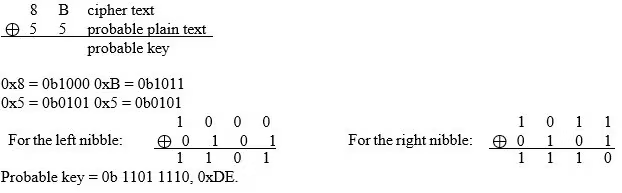
- 5.6.2.2 Step 2:
XOR second cipher text byte 0xEB with potential key 0xDE, expecting to see 0x53, plain text ASCII S.
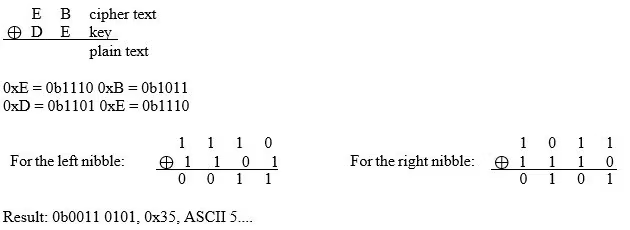
So key 0xDE did not yield 0x53 (ASCII S) but it is interesting that it yielded 0x35, a nibble switched version of the expected result.
Theory1: Probable plain text 0x55 resolved using key 0xDE as expected due to the first nibble and the second nibble having the same value, i.e. a “5” and a “5”. If the key 0xDE is used, will the nibble switched plain text byte value persist as expected?
- 5.6.2.3 Step1−1: XOR a third cipher text byte with key 0xDE nibble switching the end hex value, expecting to find a probable plain text value.
After the probable S’s, the next cipher text byte is 0xEA. If one continues to use the coin and the facility title it represents as an indication of the possible plain text, the next value could be an ASCII “C” for “Cell”. Following, if 0xEA is XOR by key 0xDE, the expected result will be the nibble switched value for ASCII C, i.e. 0x43.
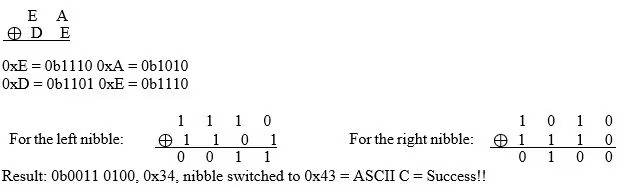
- 5.6.2.4 Step1−2: Given the success, one can now follow the pattern using key 0xDE and nibble switching the plain text byte before converting to ASCII. The process will result in solving this cipher, to include the non “guessable” bytes at the end.
5.6.3 XOR in the Wild
- If the data was saved in noncontiguous segments (allowing for a lot of plain text zeros (0) in between the track data), and all the data is ciphered (not just the track data) a simple frequency analysis should identify the most frequent hexadecimal byte.
- The most frequent ciphered byte should represent plain text ASCII 0, 0x30.
- From there, one can XOR that most frequent cipher text byte by 0x30 to determine the XOR key.
- One can then apply that key to the entire file to decipher the track data.
- If successful (Luhn validated account and other track data), one can run that key against data found in unallocated space on the SD card to potentially find more data.
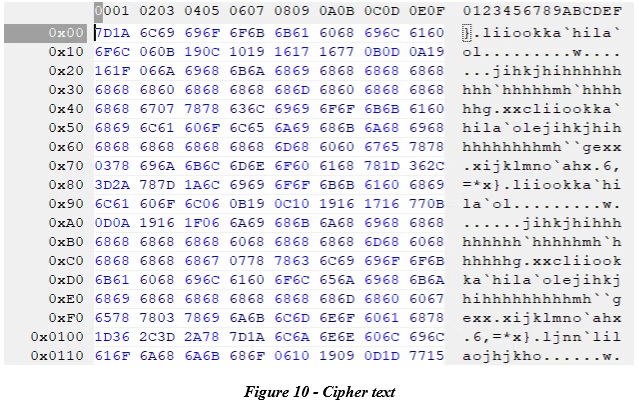
- 5.6.3.1 One may notice either through an automated frequency analysis or just by looking at the cipher text, the value 0x68 seems to be repeated a lot, possibly even used as blank space in between track data.
- 5.6.3.2 Following the above premise, one can attempt to find the key by XOR ciphering 0x68 (cipher text) by 0x30 (0, possible plain text).
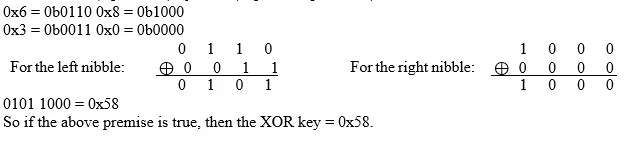
- 5.6.3.3 With 0x58 applied against the above extraction, the following data is presented:
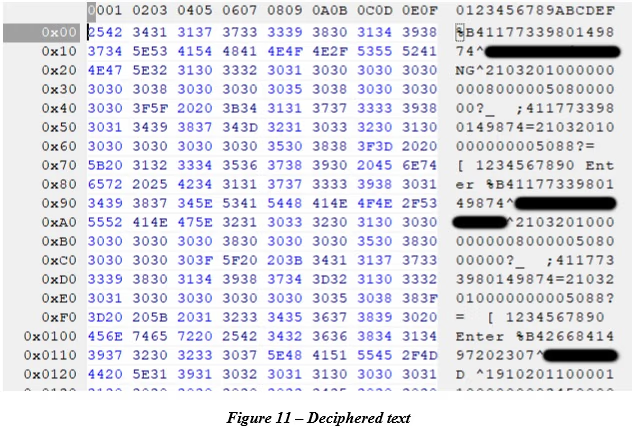
One can see that the 0x58 successfully decoded 8-bit ASCII encoded track data.
- 5.6.3.4 Ciphered data in unallocated space
In regard to SD card skimmers, after decoding data saved in any recovered file(s), using the same XOR key, one should decode track data that may reside in unallocated space on the SD card.
5.6.4 Incorrect nibbles can still be winners
Given the same parameters mentioned above (plain text of 8 bit ASCII) if one uses an incorrect first nibble of a one byte key but a correct second nibble, due to the nature of XOR ciphering data one byte cipher text by a one byte key, the resulting plain textwill properly decode the primary account numbersin a format that closely resemblesbinary coded decimal, but not the remaining track ASCII data, e.g. name
For example:
Cipher text:
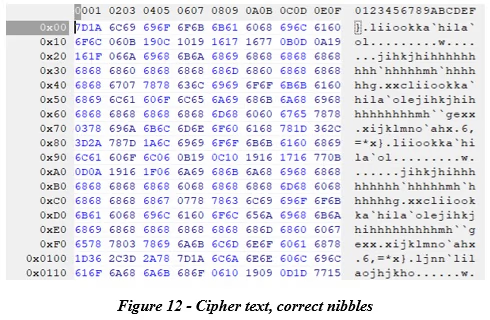
Correct key (0x58):
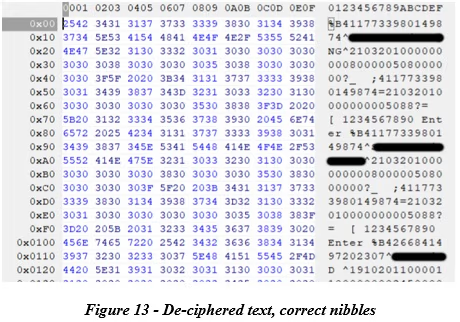
Incorrect key, but with correct second nibble (0x68)
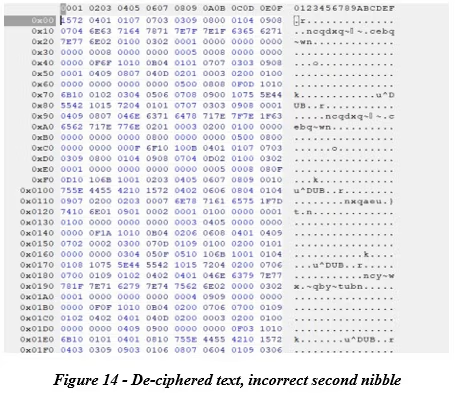
When one views the data in hex, account numbers are readable, almost as if they are padded (in this case) with a first nibble of zero, i.e. 0x04 0x01 0x01 0x07 0x07 0x3 0x3 0x9… This happens as a result of the way ASCII characters 0 – 9 are represented in hex, the fact that in this example a one byte key is used, and the XOR function itself.
Take for instance the cipher text byte of 0x6C (occurring at address 0x2). Using the correct key:
Correct key 0x58 = 0b0101 1000
Cipher text 0x6C = 0b0110 1100

As expected, the correct cipher text byte matches the plain text byte 0x34, ASCII 4, at address 0x02.
Using incorrect key:
Incorrect key 0x68 = 0b0110 1000 cipher text 0x6C = 0b0110 1100

0b0000 0100 = which does equal 0x04, but not ASCII 4
When one tries that key with a non-numeric, it also fails. As an example, the cipher text at byte address 0x14 should equal plain text ASCII S; however, using the same incorrect key yields the following:
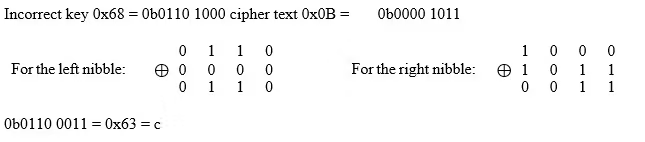
As expected, while the wrong key with correct second nibble did seem to provide the correct plain text in reference to a numerical value in an account number, it fails at other track data such as the primary account holder name, i.e. the “S”.
Why does this matter?
Earlier it was stated that there are conditions to solving a one byte cipher in this matter,
e.g. a lot of plain text zeros (0) in between the track data. However; knowing that hex only consists of a 16 character set, (0-9, A-F), if one is not able to identify the ciphered byte for plain text zero but is still working within ASCII plain text and a one byte cipher, one only needs to try a total of 16 variations in the second nibble space of a cipher key to work, i.e. 0xXY, where X = any hex character and y = 0-9, A-F. Once track data is found (as with the correct second nibble cipher used above), one can run through the 16 possibilities for the first nibble to recover full track data.
5.6.5 XOR key length variations
XOR ciphers can be of any length.
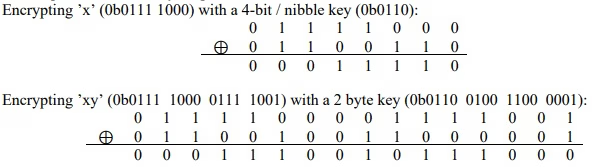
Longer keys combined with non ASCII plain text, can make XOR ciphers more difficult to resolve.
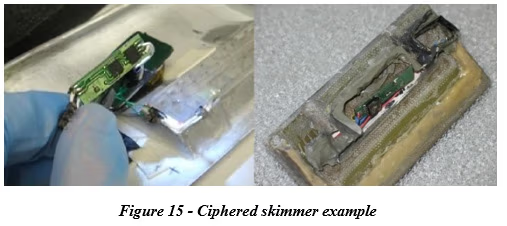
The above pictures are of a multi-byte XOR ciphered skimmer with microcontroller, decoder, and EEPROM chips.
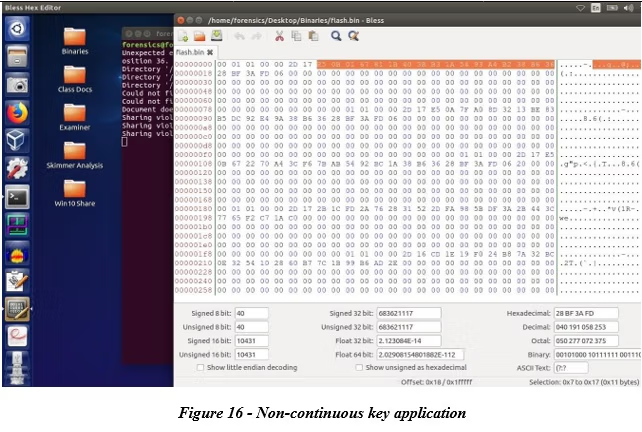
In the below image extracted from the flash chip of a skimmer resembling the above, one can see possible track data isolated by hex zeros. Notice how this cipher text is dramatically different from the previous examples. Unless the plain text was padded with a non-zero plain text byte in between the track data, the only data in the file that is ciphered is the track data.
- 5.6.5.1 Microcontroller
When attempts to recover XOR ciphered track data as previously discussed fail, one may turn to the device’s microcontroller for information that can assist in the decoding of track data. If necessary, there are decompilers that present microcontroller data in assembly language (see Appendix 2); however, many times running Strings against a microcontroller data extraction may provide a key.
- 5.6.5.2 Carve the extraction:
Strings –d filename.hex
- Note: running strings with default settings only provides hits across what one would normally see within a normal hex editor. The use of the -d switch provides hits within the data structures of the file.
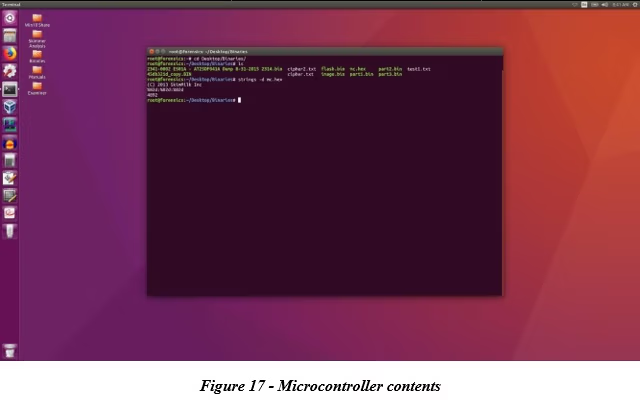
One can see the output provided a possible key of ASCII 4892.
With a possible multi-byte XOR cipher and a possible key, one needs to:
- 5.6.5.3 Locate the cipher text in a binary file;
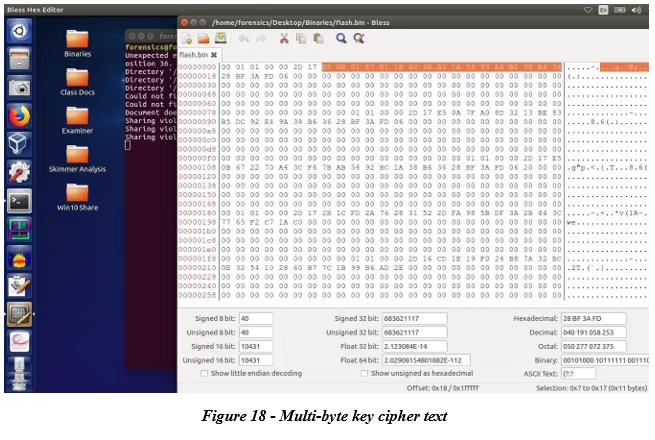
- Note: There appears to be a header that precedes each chunk of encoded account data, i.e. 0x00 01 01 00 00 2D 17. It is essential to recognize these bytes in order to determine the correct starting byte to apply the four byte key of 4892, or in base 16 hexadecimal, 0x34 38 39 Note: 17 appears to be a record length indicator, there are instances of both 17 and 16. It is unlikely that the header and length indicator are ciphered as they are consistent throughout the extraction. For this example, 17 bytes will be deciphered.
5.6.6 XOR the hex bytes by the hex value of the key;
4 = 0x34
8 = 0x38
9 = 0x39
2 = 0x32

- 5.6.6.1 Resolve those bytes to an encoding scheme that produces Luhn validated account numbers;
- Note: For this example, the final decoding to account numbers is big endian, 5-bit binary, but that may vary from device to device.
- D1 – 1101 0001
- 33 – 0011 0011
- 38 – 0011 1000
- 55 – 0101 0101
- B5 – 1011 0101
- 23 – 0010 0011
- 79 – 0111 1001
- 09 – 0000 1001
- 87 – 1000 0111
- 22 – 0010 0010
- 6D – 0110 1101
- A1 – 1010 0001
- 90 – 1001 0000
- 8A – 1000 1010
- 01 – 0000 0001
- 84 – 1000 0100
- 02 – 0000 0010
- 5.6.6.2 List the binary values as one string;
110100010011001100111000010101011011010100100011011110010000100110000111001000100110110110100
0011001000010001010000000011000010000000010
- 5.6.6.3 List the binary values as 5-bit binary little endian chunks with their corresponding account numbers values;
- 11010 – Start sentinel
- 00100 – 4
- 11001 – 3
- 10011 – 9
- 10000 – 1
- 10101 – 5
- 01101 – 6
- 10101 – 5
- 00100 – 4
- 01101 – 6
- 11100 – 7
- 10000 – 1
- 10011 – 9
- 00001 – 0
- 11001 – 3
- 00010 – 8
- 01101 – 6
The account number resolved as 4391 5654 6719 0386.
- 5.6.6.4 Luhn validation:
8 3 9 1 1 6 1 4 3 7 2 9 0 3 7 6 = 70 = valid
8 18 10 10 12 2 0 16
4 3 9 1 5 6 5 4 6 7 1 9 0 3 8 6
5.7 Automation
If manual deciphering attempts fail, one may turn to scripting solutions. See Appendix 3 for the conceptual approach to building a model and Appendix 4 for a Python 2.7 deciphering script.
6 Appendix 1 - Decoding Scripts
6.1 Main Script
					#!/usr/bin/env python2

import argparse import binascii import math
import multiprocessing
import os
import signal

from tqdm import tqdm
from skimmer_analysis import track_decode

def build_parser():
"""Build the parser used for command line options."""
parser = argparse.ArgumentParser(description="Carve credit card data from binary files.")
parser.add_argument('infile', type=argparse.FileType('rb')) parser.add_argument('--blocksize', '-b', type=int, default=2**16, dest="chunksize", help="How many bytes to handle per process. Defaults to 2**16. The larger this number, the more RAM required.")
parser.add_argument('--cores', '-c', type=int, default=None, help="How many cores to utilize while running. Defaults to maximum cores available.")
parser.add_argument('--track', '-t', type=int, default=2, dest="tracknumber", help="Which track (1 or 2) to parse data from. Track 1 returns the PAN, name, and expiration date for a card. " + "Track 2 only returns PANs. Use track number 0 to read from both track 1 and track 2. Defaults to track 2.")
parser.add_argument('--print-binary', '-p', action='store_true', dest="printbinary", help="Set this flag to make the script print out the binary form of all the found verified PANs. " + "The binary will be the same as it is in the binary file read.")
return parser

def chunk_read(file_like, chunk_size=2**16):
"""Yield chunk_size blocks from file_like object."""
file_like.seek(0)
while True:
data = file_like.read(chunk_size) if not data:
break yield data

def calculate_chunk_count(file_like, chunk_size=2**16): """Return the amount of chunks a given file will generate.
Arguments:
file_like: (file_like) File like object (open file, StringIO, etc.) chunk_size: (int) size (in bytes) of individual chunks

Returns:
int
"""
file_size = os.fstat(file_like.fileno()).st_size size = int(math.ceil(file_size / float(chunk_size))) return size

def process_track1_data(data, convert_to_binary=True): """Return all track 1 PANs found in a chunk of binary data.
Arguments:
data: (string) data to parse for track 1 encoded PANs convert_to_binary: (boolean) whether or not to convert data into a binary string. Added since wav2cc.py passes binary string for data argument. Default: True

Returns:
list of tuples
"""
records = []
if convert_to_binary:
bin_data = track_decode.get_binary_string(data) else:
bin_data = data
# check forward-swipe and backward-swipe little endian 5 bit ascii
records.extend(track_decode.search_track1_bin_string(bin_data)) records.extend(track_decode.search_track1_bin_string(bin_data[::-1], reverse_swipe=True))
# check forward-swipe and backward-swipe little endian 4 bit ascii
records.extend(track_decode.search_track1_bin_string(bin_data, parity=False)) records.extend(track_decode.search_track1_bin_string(bin_data[::-1], parity=False, reverse_swipe=True))
# check forward-swipe and backward-swipe big endian 5 bit ascii
records.extend(track_decode.search_track1_bin_string(bin_data, reverse_endian=True))

records.extend(track_decode.search_track1_bin_string(bin_data[::-1], reverse_endian=True, reverse_swipe=True))
# check forward-swipe and backward-swipe big endian 4 bit ascii
records.extend(track_decode.search_track1_bin_string(bin_data, parity=False, reverse_endian=True))
records.extend(track_decode.search_track1_bin_string(bin_data[::-1], parity=False, reverse_endian=True, reverse_swipe=True))
# check for forward-swipe binary-coded decimal
records.extend(track_decode.binary_coded_decimal_track1(binascii.hexlify(data)))
# check for backward-swipe binary-coded decimal
records.extend(track_decode.binary_coded_decimal_track1(binascii.hexlify(data[::- 1])))

# checks for ascii encoded data big_endian
records.extend(track_decode.ascii_parse_track1(data, little_endian=False))
# checks for ascii encoded data little_endian
records.extend(track_decode.ascii_parse_track1(data, little_endian=True))

# reverse the bit order in each byte
bin_data = track_decode.get_binary_string_reverse_endian(data)

# check forward-swipe and backward-swipe little endian 5 bit ascii
records.extend(track_decode.search_track1_bin_string(bin_data, data_reverse_endian=True))
records.extend(track_decode.search_track1_bin_string(bin_data[::-1], reverse_swipe=True, data_reverse_endian=True))

# check forward-swipe and backward-swipe little endian 4 bit ascii
records.extend(track_decode.search_track1_bin_string(bin_data, parity=False, data_reverse_endian=True))
records.extend(track_decode.search_track1_bin_string(bin_data[::-1], parity=False, reverse_swipe=True, data_reverse_endian=True))

# check forward-swipe and backward-swipe big endian 5 bit ascii
records.extend(track_decode.search_track1_bin_string(bin_data, reverse_endian=True, data_reverse_endian=True))
records.extend(track_decode.search_track1_bin_string(bin_data[::-1], reverse_endian=True, reverse_swipe=True, data_reverse_endian=True))

# check forward-swipe and backward-swipe big endian 4 bit ascii
records.extend(track_decode.search_track1_bin_string(bin_data, parity=False, reverse_endian=True, data_reverse_endian=True))
records.extend(track_decode.search_track1_bin_string(bin_data[::-1], parity=False, reverse_endian=True, reverse_swipe=True, data_reverse_endian=True))
# Currently no endianness reversal of the data happening here.
# These calls will rturn the same results as before.
# check for forward-swipe binary-coded decimal
#records.extend(track_decode.binary_coded_decimal_track1(binascii.hexlify(data))) # check for backward-swipe binary-coded decimal
#records.extend(track_decode.binary_coded_decimal_track1(binascii.hexlify(data[::- 1])))
# checks for ascii encoded data big_endian #records.extend(track_decode.ascii_parse_track1(data, little_endian=False)) # checks for ascii encoded data little_endian
#records.extend(track_decode.ascii_parse_track1(data, little_endian=True))

return records


def process_track2_data(data, convert_to_binary=True): """Return all track 2 PANs found in a chunk of binary data.

Arguments:
data: (string) data to parse for track 2 encoded PANs convert_to_binary: (boolean) whether or not to convert data into a binary string. Added since wav2cc.py passes binary string for data argument. Default: True
Returns:
list of tuples
"""
records = []
if convert_to_binary:
bin_data = track_decode.get_binary_string(data)
else:
bin_data = data

# check forward-swipe and backward-swipe little endian 5 bit ascii
records.extend(track_decode.search_track2_bin_string(bin_data)) records.extend(track_decode.search_track2_bin_string(bin_data[::-1], reverse_swipe=True))

# check forward-swipe and backward-swipe little endian 4 bit ascii
records.extend(track_decode.search_track2_bin_string(bin_data, parity=False)) records.extend(track_decode.search_track2_bin_string(bin_data[::-1], parity=False, reverse_swipe=True))

# check forward-swipe and backward-swipe big endian 5 bit ascii
records.extend(track_decode.search_track2_bin_string(bin_data, reverse_endian=True)) records.extend(track_decode.search_track2_bin_string(bin_data[::-1], reverse_endian=True, reverse_swipe=True))
# check forward-swipe and backward-swipe big endian 4 bit ascii
records.extend(track_decode.search_track2_bin_string(bin_data, parity=False, reverse_endian=True))
records.extend(track_decode.search_track2_bin_string(bin_data[::-1], parity=False, reverse_endian=True, reverse_swipe=True))
# check for forward-swipe binary-coded decimal
records.extend(track_decode.binary_coded_decimal_track2(binascii.hexlify(data)))
# check for backward-swipe binary-coded decimal
records.extend(track_decode.binary_coded_decimal_track2(binascii.hexlify(data[::- 1])))

# checks for ascii encoded data big_endian
records.extend(track_decode.ascii_parse_track2(data, little_endian=False))
# checks for ascii encoded data little_endian
records.extend(track_decode.ascii_parse_track2(data, little_endian=True))

# reverse the bit order in each byte
bin_data = track_decode.get_binary_string_reverse_endian(data)

# check forward-swipe and backward-swipe little endian 5 bit ascii
records.extend(track_decode.search_track2_bin_string(bin_data, data_reverse_endian=True))
records.extend(track_decode.search_track2_bin_string(bin_data[::-1], reverse_swipe=True, data_reverse_endian=True))

# check forward-swipe and backward-swipe little endian 4 bit ascii
records.extend(track_decode.search_track2_bin_string(bin_data, parity=False, data_reverse_endian=True))
records.extend(track_decode.search_track2_bin_string(bin_data[::-1], parity=False, reverse_swipe=True, data_reverse_endian=True))

# check forward-swipe and backward-swipe big endian 5 bit ascii
records.extend(track_decode.search_track2_bin_string(bin_data, reverse_endian=True, data_reverse_endian=True))
records.extend(track_decode.search_track2_bin_string(bin_data[::-1], reverse_endian=True, reverse_swipe=True, data_reverse_endian=True))

# check forward-swipe and backward-swipe big endian 4 bit ascii
records.extend(track_decode.search_track2_bin_string(bin_data, parity=False, reverse_endian=True, data_reverse_endian=True))
records.extend(track_decode.search_track2_bin_string(bin_data[::-1], parity=False, reverse_endian=True, reverse_swipe=True, data_reverse_endian=True))

# Currently no endianness reversal of the data happening here.
# These calls will rturn the same results as before.
# check for forward-swipe binary-coded decimal
#records.extend(track_decode.binary_coded_decimal_track2(binascii.hexlify(data)))
# check for backward-swipe binary-coded decimal

#records.extend(track_decode.binary_coded_decimal_track2(binascii.hexlify(data[::-1])))
# checks for ascii encoded data big_endian
#records.extend(track_decode.ascii_parse_track2(data, little_endian=False))
# checks for ascii encoded data little_endian
#records.extend(track_decode.ascii_parse_track2(data, little_endian=True))
 return records
def init_worker():
 """Ignore Interrupt signals in child processes spawned with this function."""
 signal.signal(signal.SIGINT, signal.SIG_IGN)

def auto_decode(_file, track_number, print_binary=False, chunk_size=2**16, cores=None):
 """Manages the decoding process"""
 pool = multiprocessing.Pool(cores, init_worker)
 records = []
 chunk_count = calculate_chunk_count(_file, chunk_size)
 file_chunks = chunk_read(_file, chunk_size=chunk_size)
 if track_number == 1:
 function_pool = pool.imap_unordered(process_track1_data, file_chunks)
 else:
 function_pool = pool.imap_unordered(process_track2_data, file_chunks)
 try:
 for result in tqdm(function_pool, total=chunk_count):
 records.extend(result)
 except KeyboardInterrupt:
 print("\nKeyboard interrupt caught, dumping currently scraped data...")
 pool.close()
 pool.terminate()
 finally:
 if track_number == 1:
 track_decode.print_report_track1(records, print_binary=print_binary)
 else:
 track_decode.print_report_track2(records, print_binary=print_binary)

if __name__ == '__main__':
 parser = build_parser()
 args = parser.parse_args()
 if 1 <= args.tracknumber <= 2:
 auto_decode(args.infile, args.tracknumber, print_binary=args.printbinary, chunk_size=args.chunksize, cores=args.cores)
 elif args.tracknumber == 0:
 print('Searching for track 1 data...')
 auto_decode(args.infile, 1, print_binary=args.printbinary, chunk_size=args.chunksize, cores=args.cores)
 print('\n\n\n\nSearching for track 2 data...')
auto_decode(args.infile, 2, print_binary=args.printbinary, chunk_size=args.chunksize, cores=args.cores)
 else:
 print('Track number must be 0, 1, or 2. Track number entered: %d' % args.tracknumber)
6.2 Dependency – Track Decode
					import re
import string
import sys
import binascii

from skimmer_analysis import cc_verify

if sys.version[0] == '2':
 range = xrange

def int2bin(n, count=32):
 """Return the binary of integer n, using count number of digits"""
 # return ''.join([str((n >> y) & 1) for y in range(count - 1, -1, -1)])
 fmt_string = "{:0%db}" % count
 return fmt_string.format(n)

def get_binary_string(s):
 """Return a string of ascii 1's and 0's"""
 return ''.join([int2bin(ord(c), 8) for c in s])

def get_binary_string_reverse_endian(s):
 """Return a string of ascii 1's and 0's in reverse endian (bit order per
byte)"""
 return ''.join([int2bin(ord(c), 8)[::-1] for c in s])
# hexadecimal to binary conversion
n2b = {
 '0': '0000',
 '1': '0001',
 '2': '0010',
 '3': '0011',
 '4': '0100',
 '5': '0101',
 '6': '0110',
 '7': '0111',
 '8': '1000',
 '9': '1001',
 'a': '1010',
 'b': '1011',
 'c': '1100',
 'd': '1101',
 'e': '1110',
 'f': '1111',
}

# five bit ascii encoding scheme (4 bits + 1 parity)
f2a = {
 '00001': '0', # (0H) Data
 '10000': '1', # (1H)
 '01000': '2', # (2H)
 '11001': '3', # (3H)
 '00100': '4', # (4H)
 '10101': '5', # (5H)
 '01101': '6', # (6H)
 '11100': '7', # (7H)
 '00010': '8', # (8H)
 '10011': '9', # (9H)
 '01011': ':', # (AH) Control
 '11010': ';', # (BH) Start Sentinel
 '00111': '<', # (CH) Control
 '10110': '=', # (DH) Field Separator
 '01110': '>', # (EH) Control
 '11111': '?', # (FH) End Sentinel<>
}

# seven bit ascii encoding scheme (6 bits + 1 parity)
s2a = {
 '0000001': ' ', # (0H) Special
 '1000000': '!', # (1H) "
 '0100000': '"', # (2H) "
 '1100001': '#', # (3H) "
 '0010000': '$', # (4H) "
 '1010001': '%', # (5H) Start Sentinel
 '0110001': '&', # (6H) Special
 '1110000': "'", # (7H) "
 '0001000': '(', # (8H) "
 '1001001': ')', # (9H) "
 '0101001': '*', # (AH) "
 '1101000': '+', # (BH) "
 '0011001': ',', # (CH) "
 '1011000': '-', # (DH) "
 '0111000': '.', # (EH) "
 '1111001': '/', # (FH) "

 '0000100': '0', # (10H) Data (numeric)
 '1000101': '1', # (11H) "
 '0100101': '2', # (12H) "
 '1100100': '3', # (13H) "
 '0010101': '4', # (14H) "
 '1010100': '5', # (15H) "
 '0110100': '6', # (16H) "
 '1110101': '7', # (17H) "
 '0001101': '8', # (18H) "
 '1001100': '9', # (19H) "

 '0101100': ':', # (1AH) Special
 '1101101': ';', # (1BH) "
 '0011100': '<', # (1CH) "
 '1011101': '=', # (1DH) "
 '0111101': '>', # (1EH) "
 '1111100': '?', # (1FH) End Sentinel
 '0000010': '@', # (20H) Special

 '1000011': 'A', # (21H) Data (alpha)
 '0100011': 'B', # (22H) "
 '1100010': 'C', # (23H) "
 '0010011': 'D', # (24H) "
 '1010010': 'E', # (25H) "
 '0110010': 'F', # (26H) "
 '1110011': 'G', # (27H) "
 '0001011': 'H', # (28H) "
 '1001010': 'I', # (29H) "
 '0101010': 'J', # (2AH) "
 '1101011': 'K', # (2BH) "
 '0011010': 'L', # (2CH) "
 '1011011': 'M', # (2DH) "
 '0111011': 'N', # (2EH) "
 '1111010': 'O', # (2FH) "
 '0000111': 'P', # (30H) "
 '1000110': 'Q', # (31H) "
 '0100110': 'R', # (32H) "
 '1100111': 'S', # (33H) "
 '0010110': 'T', # (34H) "
 '1010111': 'U', # (35H) "
 '0110111': 'V', # (36H) "
 '1110110': 'W', # (37H) "
 '0001110': 'X', # (38H) "
 '1001111': 'Y', # (39H) "
 '0101111': 'Z', # (3AH) "

 '1101110': '[', # (3BH) Special
 '0011111': '\\', # (3DH) Special
 '1011110': ']', # (3EH) Special
 '0111110': '^', # (3FH) Field Separator
 '1111111': '_', # (40H) Special
}

# five and seven bit ascii without parity
f2a_np = {}
for key in f2a.keys():
 f2a_np[key[:-1]] = f2a[key]
s2a_np = {}
for key in s2a.keys():
 s2a_np[key[:-1]] = s2a[key]

# binary coded decimal
bin_dec = {
 '00': 0,
 '01': 1,
 '02': 2,
 '03': 3,
 '04': 4,
 '05': 5,
 '06': 6,
 '07': 7,
 '08': 8,
 '09': 9,
}

def trans_string(transforms, track):
 """Returns a string that explains the transformations done on the
 binary to find PANs.
 Arguments:
 transforms: (string) the string of transformation codes
 generated by the PAN parsing methods
 track: (int) which track the associated PAN was carved from
 Returns:
 string
 """
 ret = 'Printing all '
 if transforms[0] == '0':
 ret += 'binary encoded, '
 elif transforms[0] == '1':
 if transforms[1] =='1':
 return ret + 'ascii, reverse endian (bit-order in byte), track %d PANs' % track
 return ret + 'ascii track %d PANs' % track
 else:
 ret += 'binary coded decimal track %d PANs' % track
 return ret
 if transforms[1] =='1':
 ret += 'reverse endian (bit-order in byte), '
 if transforms[2] == '1':
 ret += 'reverse swipe, '
 else:
 ret += 'forward swipe, '
 if transforms[3] == '1':
 ret += 'reverse endian (bit-order in character), '
 if '1' not in transforms[1:3]:
 ret = ret[:len(ret)-2] + ' '
 if transforms[4] == '1':
 if track == 1:
 ret += '7-bit PANs'
 else:
 ret += '5-bit PANs
else:
 if track == 1:
 ret += '6-bit PANs'
 else:
 ret += '4-bit PANs'
 return ret

def sort_ccs(unsorted_ccs, track):
 """Sort PANs into groups based on the transformations done on the
 binary in order to find the PAN.
 Arguments:
 unsorted_ccs: (list of tuples) the list of PANs found by the
 PAN parsing methods
 track: (int) which track the associated PANs were carved from
 """
 trans_data = 4 # location of transformation sequence in tuple
 if track == 2:
 trans_data = 2
 sorted_ccs = {}
 for cc in unsorted_ccs:
 if cc[trans_data] not in sorted_ccs.keys():
 sorted_ccs[cc[trans_data]] = [trans_string(cc[trans_data], track), cc]
 else:
 sorted_ccs[cc[trans_data]].append(cc)
return sorted_ccs

def print_report_track1(unsorted_ccs, print_binary=False, print_stream=None):
 """Print out the reults from parsing the data for track 1 PANs.
 Arguments:
 unsorted_ccs: (list of tuples) the list of PANs found by the
 PAN parsing methods
 print_binary: (boolean) whether or not to print the raw binary
 of the verified PANs. Defaults to False
 """
 # printstream management
 temp_stream = None
 if print_stream:
 # save the print stream currently in use
 temp_stream = sys.stdout
 # overwrite the print stream to use
 sys.stdout = print_stream
 # if nothing found, print that and return to avoid errors
 if len(unsorted_ccs) == 0:
 print('\nNo track 1 PANs found.')
 return
 # initialize the array for validating PANs
 file_lines = cc_verify.read_file()

# used for printing out overall stats
 all_count = 0
 all_verified_count = 0
 all_ccs = set()
 all_verified = set()
 # sort the PANs, then loop to print all PANs from each group
 sorted_ccs = sort_ccs(unsorted_ccs, 1)
 sorted_keys = sorted_ccs.keys()
 first_loop = True # to make output look a bit cleaner
 for cc_key in sorted_keys: # loop group-by-group
 sort_data = sorted_ccs[cc_key]
 # print out a line of *'s between each group for readability
 if not first_loop:
 print '\n**********************************************************************************'
 print '**********************************************************************************'
 first_loop = False
 # print out the string of transformations
 print '\n%s' % sort_data[0]
 ccs = sort_data[1:]
 all_count += len(ccs)
 # now check each PAN within the group
 print('\nPossible PANs found:')
 print('\t%20s\t%25s\t%5s' % ('PAN', 'Name', 'Expiration Date'))
 for cc in ccs:
 all_ccs.add(cc[0])
 print('\t%20s\t%25s\t%5s' % (cc[0], cc[1], cc[2]))
 print('\nUnique Luhn-verified PANs found:')
 if not print_binary:
 print('\t%20s\t%25s\t%25s\t%5s\t%5s' % ('PAN', 'Issuer', 'Name', 'Exp Date', 'Count'))
 else:
 print('\t%20s\t%25s\t%25s\t%5s\t%5s\t%10s' % ('PAN', 'Issuer', 'Name', 'Exp Date', 'Count', 'Binary PAN'))
 unique_ccs = list(set(ccs))
 # Find the unique PAN count while working around duplicate
 # numbers with different binaries (which are not removed
 # by the previous line of code)
 unique_cc_count = len(set([cc[0] for cc in ccs]))
 total_verified = 0
 unique_verified = set()
 for cc in unique_ccs:
 card_data = cc_verify.verify_cc(cc[0], file_data=file_lines)
 if card_data: # is not None
 all_verified_count += ccs.count(cc)
 all_verified.add(cc[0])
 iss = card_data["Scheme"]
 total_verified += ccs.count(cc)
 unique_verified.add(cc[0])
 if not print_binary:


 # PAN, issuer, name, expire, count
 print('\t%20s\t%25s\t%25s\t%8s\t%5s' % (cc[0], iss, cc[1], cc[2], ccs.count(cc)))
 else:
 # PAN, issuer, name, expire, count, binary
 print('\t%20s\t%25s\t%25s\t%8s\t%5s\t%-1s' % (cc[0], iss, cc[1], cc[2], ccs.count(cc), cc[3]))
 print('\n')
 print('Total possible PANs found: %s' % len(ccs))
 print('Total possible unique PANs found: %s' % unique_cc_count)
 print('Total Luhn-verified PANs: %s' % total_verified)
 print('Total unique Luhn-verified PANs: %s' %
len(unique_verified))
 # now print out the overall stats
 print '\n**********************************************************************************'
 print '**********************************************************************************'
 print '\nOverall statistics for all found PANs:'
 print('\nUnique possible PANs found:')
 for cc in all_ccs:
 print('\t' + cc)
 print('\nUnique Luhn-verified PANs found:')
 for cc in all_verified:
 print('\t' + cc)
 print('\n')
 print('Total possible PANs found: %s' % all_count)
 print('Total possible unique PANs found: %s' % len(all_ccs))
 print('Total Luhn-verified PANs: %s' % all_verified_count)
 print('Total unique Luhn-verified PANs: %s' % len(all_verified))
 # restore the previous print stream if it was overwritten
 if print_stream:
 sys.stdout = temp_stream

def print_report_track2(unsorted_ccs, print_binary=False, print_stream=None):
 """Print out the reults from parsing the data for track 1 PANs.
 Arguments:
 unsorted_ccs: (list of tuples) the list of PANs found by the PAN parsing methods
 print_binary: (boolean) whether or not to print the raw binary
 of the verified PANs. Defaults to False
 """
 # printstream management
 temp_stream = None
 if print_stream:
 # save the print stream currently in use
 temp_stream = sys.stdout

 # overwrite the print stream to use
 sys.stdout = print_stream
 # if nothing found, print that and return to avoid errors
 if len(unsorted_ccs) == 0:
 print('\nNo track 2 PANs found.')
 return
 # initialize the array for validating PANs
 file_lines = cc_verify.read_file()
 # sets used for printing out overall stats
 all_count = 0
 all_verified_count = 0
 all_ccs = set()
 all_verified = set()
 # sort the PANs, then loop to print all PANs from each group
 sorted_ccs = sort_ccs(unsorted_ccs, 2)
 sorted_keys = sorted_ccs.keys()
 first_loop = True # to make output look a bit cleaner
 for cc_key in sorted_keys: # loop group-by-group
 sort_data = sorted_ccs[cc_key]
 # print out a line of *'s between each group for readability
 if not first_loop:
 print '\n**********************************************************************************'
 print '**********************************************************************************'
 first_loop = False
 # print out the string of transformations
 print '\n%s' % sort_data[0]
 ccs = sort_data[1:]
 all_count += len(ccs)
 # now check each PAN within the group
 print('\nPossible PANs found:')
 for cc in ccs:
 all_ccs.add(cc[0])
 print('\t' + str(cc[0]))
 print('\nUnique Luhn-verified PANs found:')
 if not print_binary:
 print('\t%20s\t%25s\t%5s' % ('PAN', 'Issuer', 'Count'))
 else:
 print('\t%20s\t%25s\t%5s\t%10s' % ('PAN', 'Issuer', 'Count', 'Binary PAN'))
 unique_ccs = list(set(ccs))
 # Find the unique PAN count while working around duplicate
 # numbers with different binaries (which are not removed
 # by the previous line of code)
 unique_cc_count = len(set([cc[0] for cc in ccs]))
 total_verified = 0
 unique_verified = set()
 for cc in unique_ccs:
 card_data = cc_verify.verify_cc(cc[0], file_data=file_lines)
 if card_data: # is not None

 all_verified_count += ccs.count(cc)
 all_verified.add(cc[0])
 iss = card_data["Scheme"]
 total_verified += ccs.count(cc)
 unique_verified.add(cc[0])
 if not print_binary:
 # PAN, issuer, count
print('\t%20s\t%25s\t%5s' % (cc[0], iss, ccs.count(cc)))
 else:
 # PAN, issuer, count, binary
 print('\t%20s\t%25s\t%5s\t%-1s' % (cc[0], iss, ccs.count(cc), cc[1]))
 print('\n')
 print('Total possible PANs found: %s' % len(ccs))
 print('Total possible unique PANs found: %s' % unique_cc_count)
 print('Total Luhn-verified PANs: %s' % total_verified)
 print('Total unique Luhn-verified PANs: %s' % len(unique_verified))
 # now print out the overall stats
 print '\n**********************************************************************************'
 print '**********************************************************************************'
 print '\nOverall statistics for all found PANs:'
 print('\nUnique possible PANs found:')
 for cc in all_ccs:
 print('\t' + cc)
 print('\nUnique Luhn-verified PANs found:')
 for cc in all_verified:
 print('\t' + cc)
 print('\n')
 print('Total possible PANs found: %s' % all_count)
 print('Total possible unique PANs found: %s' % len(all_ccs))
 print('Total Luhn-verified PANs: %s' % all_verified_count)
 print('Total unique Luhn-verified PANs: %s' % len(all_verified))
 # restore the previous print stream if it was overwritten
 if print_stream:
 sys.stdout = temp_stream

def ascii_parse_track1(data, little_endian=False):
 """Returns all track 1 PANs found in ascii format
 Arguments:
 data: (string) the string to search for track 1 PANs
 little_endian: (boolean) whether or not to reverse the endianness (bit order in each byte) of the data
 Returns:
 list of tuples """

 # if little_endian, reverse the endianness
 if little_endian:
 bin_data = get_binary_string_reverse_endian(data)
 out = ''
 for idx in range(0, len(data)):
 out += str(chr(int(bin_data[idx*8:idx*8+7],2)))
 data = out
 # regex for full credit card data
 reg1 = '%.([0-9]{13,19})\^([A-Z /]{2,26})\^([0-9]{4}).{0,50}\?.'
 pat1 = re.compile(reg1)
 # regex for missing expiration date
 reg2 = '%.([0-9]{13,19})\^([A-Z /]{2,26})\^'
 pat2 = re.compile(reg2)
 # regex for missing name
 reg3 = '%.([0-9]{13,19})\^'
 pat3 = re.compile(reg3)
 # Use a dictionary at first to store PANs found so the same PAN
 # isn't read as 3 different PANs by each regex. Dictionary keys
 # are the positions at which the regexes find the match.
 card_dict = {}

 # search first for PANs while ignoring name and expiration date
 res = pat3.search(data, pos=0)
 while res is not None:
 bin = get_binary_string(res.group(1))
 transforms = transformations(type=1,reverse_endian=little_endian)
 card_dict[res.pos] = (res.group(1),'N/A','N/A',bin,transforms)
 res = pat3.search(data, pos=res.start() + 1)

 # search for names with PANs previously found
 res = pat2.search(data, pos=0)
 while res is not None:
 bin = get_binary_string(res.group(1))
 transforms = transformations(type=1,reverse_endian=little_endian)
 card_dict[res.pos] = (res.group(1),res.group(2),'N/A',bin,transforms)
 res = pat2.search(data, pos=res.start() + 1)

 # search for expiration dates for PANs previously found
 res = pat1.search(data, pos=0)
 while res is not None:
 bin = get_binary_string(res.group(1))
 transforms = transformations(type=1,reverse_endian=little_endian)
 card_dict[res.pos] = (res.group(1),res.group(2),res.group(3),bin,transforms)
 res = pat1.search(data, pos=res.start() + 1)

 # now convert the dictionary of PANs to a list to return
 valid_cards = []
 for key in card_dict.keys():
 valid_cards.append(card_dict[key])

 #return [] #for testing only the bin_data decode
 return valid_cards

def ascii_parse_track2(data, little_endian=False):
 """Returns all track 1 PANs found in ascii format
 Arguments:
 data: (string) the string to search for track 1 PANs
 little_endian: (boolean) whether or not to reverse the endianness (bit order in each byte) of the data
 Returns:
 list of tuples
 """
 # if little_endian, reverse the endianness
 if little_endian:
 bin_data = get_binary_string_reverse_endian(data)
 out = ''
 for idx in range(0, len(data)):
 out += str(chr(int(bin_data[idx*8:idx*8+7],2)))
 data = out

 # regex for full track 2 format
 t2_re = ';([0-9]{13,19})=.{1,30}\?.'
 pat_t2 = re.compile(t2_re)
 valid_cards = []

 # search for all track 2 PANs
 res = pat_t2.search(data, pos=0)
 while res is not None:
 bin = get_binary_string(res.group(1))
 transforms = transformations(type=1,reverse_endian=little_endian)
 valid_cards.append((res.group(1), bin,transforms))
 res = pat_t2.search(data, pos=res.start() + 1)

 #return [] # for testing only the bin_data decode
 return valid_cards

 def track1_exists(data, parity, reverse_endian):
 """Searches for any track 1 tart sentinels, then prints out the next few characters using the seven-bit to ascii dictionary. If the binary is an invalid character, '~' gets printed in its place. Use this function to do a semi-manual search for track 1 encoded data in a file.
 Arguments:
 """

aximum length of chars to read/print
 max_len = 50
 # minimum number of valid chars in a result for it to be printed
 min_len = 5
 # minimum number of digits in a result for it to be printed
 min_digs = 5
 # whether or not the result must match the regex to be printed
 use_reg = True
 # regex for the start of a valid PAN
 # (without a minimum length requirement)
 reg = re.compile('%.([0-9]{0,19})\^')

# Mostly the same as search_bin_string() methods, but upon finding
 # a possible PAN, check if it meets the requirements to be printed.
 # If it meets all requirements, then print out the found string.
 if parity:
 char_size = 7
 else:
 char_size = 6
 sentinel = '1010001'[:char_size]
 if reverse_endian:
 sentinel = sentinel[::-1]

while data.find(sentinel) != -1:
 index = data.find(sentinel) + char_size
 startIdx = index - char_size + 1
 toPrint = ''
 digits = 0
 while len(toPrint) < max_len:
 a_char = lookup(data[index:index + char_size], parity, reverse_endian)
 if a_char in s2a.keys():
 toPrint += s2a[a_char]
 if s2a[a_char] in string.digits:
 digits += 1
 else:
 toPrint += '~'
 index += char_size
 if use_reg:
 res = reg.search(toPrint)
 if res is not None:
 print toPrint
 else:
 if len(toPrint) > min_len and digits > min_digs and toPrint[0] in string.uppercase:
 print toPrint
 data = data[startIdx:]
 return []

 def transformations(type=0, parity=True, reverse_endian=False,
reverse_swipe=False, data_reverse_endian=False):
 """Returns a string of an encoded list of all transformations done on some data in order to find some PAN.
 Arguments:
 type: (int) What encoding the PAN was in. 0 for track-specific ascii, 1 for plain ascii, 2 for binary-coded decimal.
 Defaults to 0.
 parity: (boolean) Whether or not the parity bit is included in in the binary. Only applies to type = 0. Defaults to True.
 reverse_endian: (boolean) Whether or not the characters had a bit-wise endian reversal. Only applies to type != 2.
 Defaults to False.
 reverse_swipe: (boolean) Whether or not the PAN was read as a reverse swipe. (Currently) only applies to type = 0.
 Defaults to False.
 data_reverser_endian: (boolean) Whether or not the data that the PAN was parsed from had a bit-order per byte endianness reversal. Defaults to False.
 Returns:
 string
 """
 return str(type) + str(int(data_reverse_endian)) + str(int(reverse_swipe)) +
str(int(reverse_endian)) + str(int(parity))

def search_track1_bin_string(data, parity=True, reverse_endian=False, reverse_swipe=False, data_reverse_endian=False):
 """Returns all seven-bit encoded track 1 PANs in a chunk of data.
 Arguments:
 data: (string) the binary string to parse for PANs
 parity: (boolean) whether or not the characters have the parity bit included. Defaults to True.
 reverse_endian: (boolean) whether or not the characters are in reverse bit order. Defaults to False.
 reverse_swipe: (boolean) whether or not the data passed in is reversed from the original. Defaults to False.
 data_reverse_endian: (boolean) whether or not the data passed in is reverse endian (bit-order in each byte) from the original. Defaults to False.
 Returns:
 list of tuples
 """
 # uncomment to check if any track 1 data exists
 #return track1_exists(data, parity, reverse_endian)
 # set the char_size and sentinel based on parity and reverse_endian
 if parity:
 char_size = 7
 else:
 char_size = 6
 sentinel = '1010001'[:char_size]
 if reverse_endian:
 sentinel = sentinel[::-1]

records = []
 index = 0
 # Start at every start sentinel location. Since data is cut at
 # byte boundaries, use mod 8 to resume search from 'index'.
 while data[index % 8:].find(sentinel) != -1 and len(data) > 8:
 # Whether or not we hit a field separator to break from the
 # previous loop. We'll search for the next field only if the
 # previous fields are in a valid format.
 valid_break = False
 # whether or not we found a potential PAN
 valid_number = False
 index = data[index % 8:].find(sentinel) + (index % 8) + char_size
 startIdx = index # placeholder for the start index of the PAN
 cc = '' # ascii PAN
 ccbin = '' # binary representation of the PAN
 name = 'N/A'
 exp = 'N/A' # expiration date
 # in track 1, ignore the first char after the sentinel
 index += char_size
 # loop to serach for the PAN
 while index + char_size <= len(data):
 a_char = lookup(data[index:index + char_size], parity, reverse_endian)
 # if a_char is a digit in the seven-bit ascii encoding
 if a_char in s2a.keys() and s2a[a_char] in string.digits: cc += s2a[a_char]
 else:
 # if a_char is a field separator and the PAN is a valid length
 if a_char in s2a.keys() and s2a[a_char] == '^' and 13 <= len(cc) <= 19:
 index += char_size # make sure we skip over the field separator
 valid_number = True # breaking out of loop due to a field separator
 valid_break = True # " "
 # else: # not in s2a.keys(), not a digit, nor a field separator
 # no need to change valid_number or valid_break since we started by setting them to false
 break
 index += char_size
 # now try getting the name if the credit card number is valid
 while index + char_size <= len(data) and valid_break:
 a_char = lookup(data[index:index + char_size], parity, reverse_endian)
 # a_char is a valid char (uppercase letter, space, or slash)
 if a_char in s2a.keys() and s2a[a_char] in (string.uppercase + ' /'):
 name += s2a[a_char]
 else:
 if a_char in s2a.keys() and s2a[a_char] == '^': # if a_char is a field separator
 index += char_size # make sure we skip over the field separator
 else: # we hit a completely invalid char
 name = 'N/A'
 valid_break = False
 break
 if len(name) > 26: # valid char appended, but now the name is over the size limit
 name = 'N/A'
 valid_break = False
 break
 index += char_size
 # now try to get the expiration date if we got the name correctly, otherwise we probably can't get it
 while index + char_size <= len(data) and valid_break:
 a_char = lookup(data[index:index + char_size], parity, reverse_endian)
 if a_char in s2a.keys() and s2a[a_char] in string.digits: # if a_charis a digit
 exp += s2a[a_char]
 else:
 exp = 'N/A'
 break
 if len(exp) == 4: # we have the full expiration date, so break
 break
 index += char_size

 # if the PAN found is a valid format, undo the reverse_swipe
 # and data_reverse_endian transformations on the binary PAN
 # and add it to the results list
 if valid_number:
 if not data_reverse_endian: # if data did NOT have endianness swapped before function call
 ccbin = data[startIdx:index]
 if reverse_swipe: # all we need to worry about is the reverse swipe
 ccbin = ccbin[::-1]
 if data_reverse_endian: # if data DID have endianness swapped before function call
 startIdx -= startIdx % 8 # move the start index back to the beginning of the nearest byte
 endIdx = index + (8 - (index % 8)) # move the end index forward to the end of the nearest byte
 ccbin = data[startIdx:endIdx] # now we grab out binary PAN
 if reverse_swipe: # since reverse swipe happens after the endianness swap, undo it before the endianness swap
 ccbin = ccbin[::-1]
 newccbin = '' # temporary variable to hold the binary PAN as we do an endianness swap
 for i in range(0, len(ccbin)/8): # reverse the bit order in each byte
 newccbin += ccbin[i*8:(i*8)+8][::-1]
 ccbin = newccbin # set ccbin to the corrected binary PAN

 transforms = transformations(type=0, parity=parity,reverse_endian=reverse_endian,reverse_swipe=reverse_swipe,data_rever se_endian=data_reverse_endian)
 records.append((cc, name, exp, ccbin, transforms))
 data = data[index - (index % 8):] # cut off data at the first byte before the index specified by 'index'
 return records

def search_track2_bin_string(data, parity=True, reverse_endian=False,
reverse_swipe=False, data_reverse_endian=False):
 """Returns all seven-bit encoded track 1 PANs in a chunk of data.
 Arguments:
 data: (string) the binary string to parse for PANs
 parity: (boolean) whether or not the characters have the parity bit included. Defaults to True.
 reverse_endian: (boolean) whether or not the characters are in reverse bit order. Defaults to False.
 reverse_swipe: (boolean) whether or not the data passed in is reversed from the original. Defaults to False.
 data_reverse_endian: (boolean) whether or not the data passed in is reverse endian (bit-order in each byte) from the original. Defaults to False.
 Returns:
 list of tuples
 """
 # Strict search was to use 2 additional search requirements
 # (length and field separator). It was added to resolve the
 # incosistency between the ascii regex and binary search, but
 # is currently disabled until some more testing is done.
 strict = False

 # set the char_size and sentinel based on parity and reverse_endian
 if parity:
 char_size = 5
 else:
 char_size = 4
 sentinel = '11010'[:char_size]
 if reverse_endian:
 sentinel = sentinel[::-1]
 records = []
 index = 0
 # Start at every start sentinel location. Since data is cut at
 # byte boundaries, use mod 8 to resume search from 'index'.
 while data[index%8:].find(sentinel) != -1 and len(data) > 8:
 index = data[index%8:].find(sentinel) + (index % 8) + char_size
 startIdx = index # placeholder for the start index of the PAN
 cc = ''
 ccbin = '' # binary of PAN
 valid_break = not strict # strict - assume invalid break; not strict - any break is valid
 # check the next 5 bits, if a valid number keep going else stop
 while index + char_size <= len(data):

 a_char = lookup(data[index:index + char_size], parity, reverse_endian)
# get the char for lookup
 if strict and a_char in f2a.keys() and f2a[a_char] in string.digits and len(cc) < 19: # strict search
 cc += f2a[a_char]
 elif a_char in f2a.keys() and f2a[a_char] in string.digits: # relaxed search
 cc += f2a[a_char]
 else:
 if strict and a_char in f2a.keys() and f2a[a_char] == '=': # if doing a strict search, check for field separator
 valid_break = True # valid break if we break because of a field separator
 break
 index += char_size
 # if the PAN found is a valid format, undo the reverse_swipe
 # and data_reverse_endian transformations on the binary PAN
 # and add it to the results list
 if valid_break and 13 <= len(cc) <= 19:
 if not data_reverse_endian: # if data did NOT have endianness swapped before function call
 ccbin = data[startIdx:index]
 if reverse_swipe: # all we need to worry about is the reverse swipe
 ccbin = ccbin[::-1]
 if data_reverse_endian: # if data DID have endianness swapped before function call
 startIdx -= startIdx % 8 # move the start index back to the beginning of the nearest byte
 endIdx = index + (8 - (index % 8)) # move the end index forward to the end of the nearest byte
 ccbin = data[startIdx:endIdx] # now we grab out binary PAN
 if reverse_swipe: # since reverse swipe happens after the endianness swap, undo it before the endianness swap
 ccbin = ccbin[::-1]
 newccbin = '' # temporary variable to hold the binary PAN as we do an endianness swap
 for i in range(0, len(ccbin)/8): # reverse the bit order in each byte
 newccbin += ccbin[i*8:(i*8)+8][::-1]
 ccbin = newccbin # set ccbin to the corrected binary PAN
 transforms = transformations(type=0, parity=parity, reverse_endian=reverse_endian, reverse_swipe=reverse_swipe, data_reverse_endian=data_reverse_endian)
 records.append((cc, ccbin, transforms))
 data = data[index - (index % 8):] # cut off data at the first byte before the index specified by 'index'
 return records

 def unique_swipes(ccs):
 return list(set(ccs))

def binary_coded_decimal_track1(hex_data):
 """Returns all track 1 PANs found encoded in binary-coded decimal.
 Currently the only difference between track 1 and track 2 is the format of the returned tuples.
 Arguments:
 hex_data: (string) the data to search in hexadecimal format
 Returns:
 list of tuples
 """
 hex_bytes = [hex_data[i:i + 2] for i in range(0, len(hex_data), 2)]
 records = []
 cc = ''
 ccbin = ''
 for i in range(len(hex_bytes)):
 a_char = hex_bytes[i]
 if a_char in bin_dec.keys():
 cc += str(bin_dec[a_char])
 ccbin += a_char
 else:
 if 13 <= len(cc) <= 19:
 transforms = transformations(type=2)
 records.append((cc,'N/A','N/A',ccbin,transforms))
 cc = ''
 ccbin = ''
 if 13 <= len(cc) <= 19:
 transforms = transformations(type=2)
 records.append((cc,'N/A','N/A',ccbin,transforms))
 return records

def binary_coded_decimal_track2(hex_data):
 """Returns all track 2 PANs found encoded in binary-coded decimal.
 Currently the only difference between track 1 and track 2 is the format of the returned tuples.
 Arguments:
 hex_data: (string) the data to search in hexadecimal format
 Returns:
 list of tuples
 """
 hex_bytes = [hex_data[i:i + 2] for i in range(0, len(hex_data), 2)]
 records = []
 cc = ''
 ccbin = ''
 for i in range(len(hex_bytes)):
 a_char = hex_bytes[i]

 if a_char in bin_dec.keys():
 cc += str(bin_dec[a_char])
 ccbin += get_binary_string(binascii.unhexlify(a_char))
 else:
 if 13 <= len(cc) <= 19:
 transforms = transformations(type=2)
 records.append((cc, ccbin, transforms))
 cc = ''
 ccbin = ''
 if 13 <= len(cc) <= 19:
 transforms = transformations(type=2)
 records.append((cc, ccbin, transforms))
 return records

 def get_aba(binary_data, in_place=False, no_parity=False, reverse_endian=False):
 """ Return a tuple (error?, ascii_data) of from 5-bit ABA track 2
 Arguments:
 binary_data: a string of ascii 0's and 1's (like "01110101"...)
 in_place: must the start sentinel be at the beginning? or can we search for it?
 no_parity: are parity bits included?
 reverse_endian: is the bit endianness reversed?
 """
 if no_parity:
 width = 4
 else:
 width = 5
 aba_data = ''
 aba_error = False
 if width == 4 and reverse_endian:
 binary_data = ''.join([binary_data[4 * i + 3] + binary_data[4 * i + 2] + binary_data[4 * i + 1] + binary_data[4 * i] for i in range(len(binary_data) / 4)])
 if width == 5 and reverse_endian:
 binary_data = ''.join([binary_data[5 * i + 3] + binary_data[5 * i + 3]+binary_data[5 * i + 2]+binary_data[5 * i + 1] + binary_data[5 * i] for i in range(len(binary_data) / 5)])
 if not in_place:
 if no_parity:
 binary_data = binary_data[binary_data.find('1101'):]
 else:
 binary_data = binary_data[binary_data.find('11010'):]
 for j in range(len(binary_data) / width):
 try:
 if no_parity:
 aba_data += f2a_np[binary_data[width * j:width * j + width]]
 else:
 aba_data += f2a[binary_data[width * j:width * j + width]]
 except KeyError:
 aba_error = True
 aba_data += ' '
 return aba_error, aba_data

def get_iso(binary_data, in_place=False, no_parity=False):
 """Return a tuple (error?, ascii_data) of from 7-bit ISO track 1
 Arguments:
 binary_data: a string of ascii 0's and 1's (like "01110101"...)
 in_place: must the start sentinel be at the beginning? or can we search for it?
 no_parity: are parity bits included?
 """
 if no_parity:
 width = 6
 else:
 width = 7
 iso_data = ''
 iso_error = False
 if not in_place:
 if no_parity:
 binary_data = binary_data[binary_data.find('101000'):]
 else:
 binary_data = binary_data[binary_data.find('1010001'):]
 for j in range(len(binary_data) / width):
 try:
 if no_parity:
 iso_data += s2a_np[binary_data[width * j:width * j + width]]
 else:
 iso_data += s2a[binary_data[width * j:width * j + width]]
 except KeyError:
 iso_error = True
 iso_data += ' '
 return iso_error, iso_data

 def get_ascii7(binary_data):
 """Convert binary data from 7-bit ascii to 8-bit ascii"""
 width = 7
 ascii7 = ''
 for j in range(len(binary_data) / width):
 ascii7 += chr(int(binary_data[width * j:width * j + width], 2))
 return ascii7
def lookup(bin_char, parity, reverse_endian):
 """Normalizes a binary string for the character lookup."""
 if reverse_endian:
 bin_char = bin_char[::-1]
 if not parity:
 # add the parity bit for the lookup
 if bin_char.count('1') % 2:
 bin_char += '0'
 else:
bin_char += '1'
 return bin_char
6.3 Dependency - Credit Card Verify
					#!/usr/bin/python
import sys
import os
__doc__ = "\n\
 Usage:\n\
 %s [actions] [options] ccnumber\n\
 \n\
 Actions:\n\
 -h, --help Display this help message\n\
 -V Show version information\n\
 \n\
 Options:\n\
 --no-luhn Do not use Luhn verification\n" % (sys.argv[0])

def check_luhn(ccnumber):
 num = [int(x) for x in str(ccnumber)]
 return sum(num[::-2] + [sum(divmod(d * 2, 10)) for d in num[-2::-2]]) % 10 == 0

def verify_cc(ccnumber, file_data=None, use_luhn=True):
 """Workaround for overloading the verify_cc method. Used since both methods use different algorithms for verifying PANs
 Arguments:
 ccnumber: (string) the credit card number / PAN to verify
 file_data: (array of string) the lines of binlist.txt in array format. Defaults to None.
 use_luhn: (boolean) whether or not to use the Luhn algorithm to check the ccnumber. Defaults to True.
 Returns:
 if ccnumber is valid, a dictionary of data about ccnumber otherwise None
 """
 if file_data: # is not None:
 return verify_from_array(ccnumber, file_data=file_data, use_luhn=use_luhn)
 else:
 return verify_from_file(ccnumber, use_luhn=use_luhn)

def verify_from_array(ccnumber, file_data, use_luhn=True):
 """Verifies the ccnumber against the binlist scrape using an array
 rather than reading through the file. Much faster to use than
 verify_from_file().
 """
if use_luhn and not check_luhn(ccnumber):
 return None
 # use first 6 digits of ccnumber as the index to look at
 line = file_data[int(ccnumber[:6])]
 card_data = {}
 if line.find("Invalid Card") != -1:
 return None
 if line.find("scheme") != -1:
 card_data["Scheme"] = find_Between(line, "scheme\":\"", "\"")
 if line.find("type") != -1:
 card_data["Type"]= find_Between(line, "type\":\"", "\"")
 if line.find("brand") != -1:
 card_data["Brand"]= find_Between(line, "brand\":\"", "\"")
 if line.find("prepaid") != -1:
 card_data["Prepaid"]= find_Between(line, "\"prepaid\":", ",\"")
 if line.find("country") != -1:
 card_data["Country"]= find_Between(line, "\",\"name\":\"", "\"")
 if line.find("currency") != -1:
 card_data["Currency"]= find_Between(line, "currency\":\"", "\"")
 if line.find("\"bank\":{\"name\":\"") != -1:
 card_data["Bank Name"]= find_Between(line, "\"bank\":{\"name\":\"", "\"")
 if line.find("\"url\":\"") != -1:
 card_data["Bank URL"]= find_Between(line, "\"url\":\"", "\"")
 if line.find("phone") != -1:
 card_data["Bank Phone"]= find_Between(line, "phone\":\"", "\"")
 return card_data

def verify_from_file(ccnumber, use_luhn=True):
 """The original verify_cc written for using the binlist scrape. Incudes minor edits to some return statements and file path."""
 file_path = os.path.join(os.path.dirname(os.path.abspath(__file__)), 'ccs.txt')
 #print 'Reading data from %s' % file_path
 file_obj = open(file_path,"r")
 if use_luhn and not check_luhn(ccnumber):
 return None
 cc_num = ccnumber[:6]
 card_data = {}
 for line in file_obj:
 if cc_num + ": " in line:
 if line.find("Invalid Card") != -1:
 return None
 if line.find("scheme") != -1:
 card_data["Scheme"] = find_Between(line, "scheme\":\"", "\"")
 if line.find("type") != -1:
 card_data["Type"]= find_Between(line, "type\":\"", "\"")
 if line.find("brand") != -1:
 card_data["Brand"]= find_Between(line, "brand\":\"", "\"")
 if line.find("prepaid") != -1:
 card_data["Prepaid"]= find_Between(line, "\"prepaid\":", ",\"")
 if line.find("country") != -1:
 card_data["Country"]= find_Between(line, "\",\"name\":\"", "\"")
 if line.find("currency") != -1:
 card_data["Currency"]= find_Between(line, "currency\":\"", "\"")
 if line.find("\"bank\":{\"name\":\"") != -1:
 card_data["Bank Name"]= find_Between(line, "\"bank\":{\"name\":\"", "\"")
 if line.find("\"url\":\"") != -1:
 card_data["Bank URL"]= find_Between(line, "\"url\":\"", "\"")
 if line.find("phone") != -1:
 card_data["Bank Phone"]= find_Between(line, "phone\":\"", "\"")
 return card_data

def find_Between(s, prefix, suffix):
 """Sets search parameters to parse data"""
 try:
 start = s.index(prefix) + len(prefix)
 end = s.index(suffix, start)
 return s[start:end]
 except ValueError:
 return ""

def read_file():
 """Returns the binlist scrape results as an array. Index 0 corresponds to the first six digits being 000000, index 1 is 000001, etc."""
 file_path = os.path.join(os.path.dirname(os.path.abspath(__file__)), 'ccs.txt')
 # print 'Reading data from %s' % file_path
 file_obj = open(file_path, "r")
 lines = []
 for line in file_obj:
 lines.append(line)
 return lines

def main(args):
 import getopt
 try:
 ccnumber = args[-1]
 # note: args[1:] is not typical because first arg is always a file_name
 opts, args = getopt.getopt(args[0:], 'hV', ['help','no-luhn'])
 except getopt.GetoptError as ex:
 print >> sys.stderr, 'Invalid argument: ' + str(ex)
 print >> sys.stderr, __doc__
 sys.exit(1)
 except IndexError:
 print >> sys.stderr, 'Please specify a credit card number...'
 print >> sys.stderr, __doc__
 sys.exit(1)

 def badArguments():
  # print out usage if bad arguments are supplied
 print >> sys.stderr, 'Bad command line argument formation'
 print >> sys.stderr, __doc__
 sys.exit(1)
 use_luhn = True

 # action parsing
 for opt, arg in opts:
 # Short options
 if opt in ['-h', '--help']:
 print __doc__
 sys.exit(1)
 elif opt == '-V':
 print sys.argv[0] + ', Version ' + __version__
 sys.exit(1)

 # option parsing
 for opt, arg in opts:
 if (opt == '--no-luhn'):
 use_luhn = False
 try:
 assert ccnumber.isdigit()
 except:
 print >> sys.stderr, 'CC number must be all digits (got %s)...' % ccnumber
 print >> sys.stderr, __doc__
 sys.exit(1)

# let's do it
cc_dictionary = verify_cc(ccnumber, use_luhn = use_luhn)
 if cc_dictionary: # is not None:
 for x in cc_dictionary:
 print x,':',cc_dictionary[x]
 else:
 print ccnumber,'is not a valid credit card number.'
if __name__ == '__main__':
 #try:
 #import psyco
 #psyco.full()
 #except ImportError:
 #pass
 #print 'Psyco not installed, the program will just run slower...'
 main(sys.argv[1:])
7 Appendix 2 - Microcontroller Code Analysis
In the event when the data retrieved from the flash chip on a skimmer proves difficult to analyze, the device’s microcontroller may provide additional insight. Note: code protected microcontrollers can prevent analysis.
An example of a Bluetooth pairing name, “mariana”, is shown below:
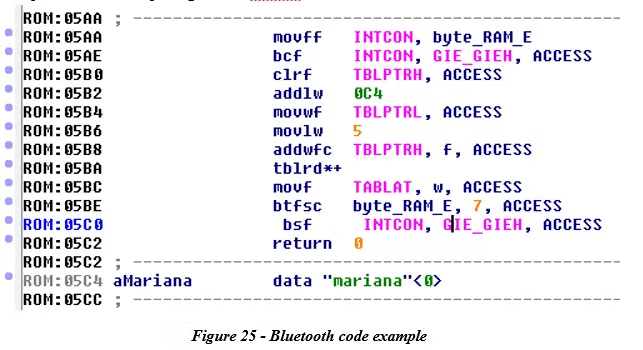
7.1 Common code examples
Typically microcontroller code is analyzed in a decompiler. What follows are some code example screen shots from such a program and an explanation of what is depicted:
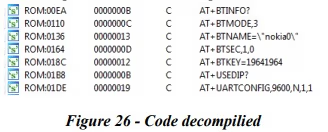
The above is a decompiler view of the configuration for a device’s Bluetooth module. Notably, the “AT+BTNAME” parameter is what the device will broadcast as its name and AT+BTKEY is the pairing key needed to connect to the device. This information could prove useful in examinations if the subject uses the same password and name for a skimmer. Also, this information could be used to link a person to a skimmer if the device the person used to connect via Bluetooth, e.g. cell phone, held corresponding information.
The below is another Bluetooth configuration parameter from the microcontroller code showing the Bluetooth pairing PIN. This can be used to possibly image the device over Bluetooth if the situation required such a process.

This below is a snippet from a microcontroller showing the C-style format string for the card data it produces. The %XXX sequences tell the microcontroller how to format the data. In this particular case, the formatting is not doing anything tricky and pretty closely resembles a track 2 record minus the field separators and sentinels.
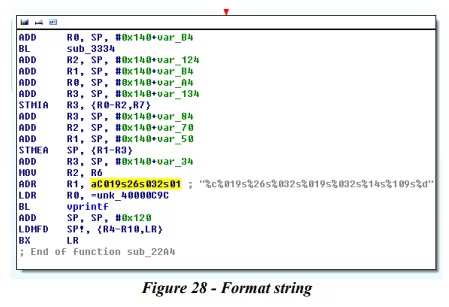
This formatting corresponds to the card data below.
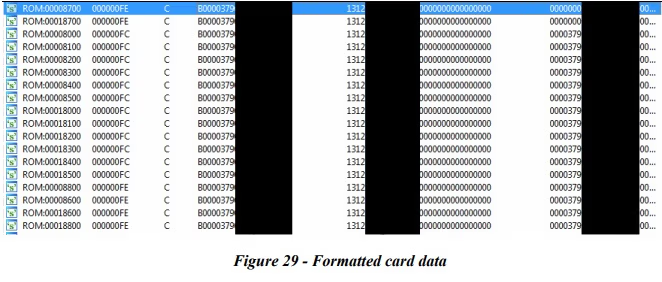
This card data was stored on the microcontroller along with the code (1 chip for both code and data). This data could have been recovered using a strings dump of the file (or a hex editor). The format is defined by the code mentioned above.
8 Appendix 3 - Modeling Skimmers with Boolean Polynomials
The following describes the process for creating scripts for use with deciphering data extracted from skimmers.
8.1 Ring
Define a ring (a field of our variables) over Z2 = {0, 1}:
R = Z2[k0 . . . km−1, p0 . . . pn−1, c0 . . . cn−1]
Where m is the key length in bits and n is out cipher text/plain text length in bits.
8.2 Polynomials
These variables are used in sets of Boolean polynomials that describe some aspect of the skimmer.
- First polynomial
It was stated that pi ⊕ kj = ci. As every Boolean polynomial defined must be equal to zero, XOR both sides of the equation by ci so now rpi + kj + ci = 0.
Fcipher = {pi + kj + ci : j = i modulo m and 0 ≤ i < n}
- Second polynomial
Note that every track 2 character has an odd parity bit as its fifth bit.
So, pi + pi1 + pi2 + pi3 + pi4 + 1 = 0 where i is the first bit of the character is always true.
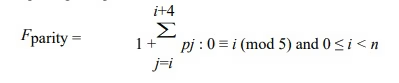
Other equations:
- Key restriction to printable ASCII
- Decimal and other value-restricted fields
- Absence of specific control characters
- Predictability of control character locations
- Luhn verification of the primary account number
- Longitudinal redundancy check (LRC)
8.3 Cipher bits
Create known cipher text equations that define what the cipher text bits are. For every cipher text bit, define the polynomial:
- ci if the ith cipher text bit is zero
- ci + 1 if the ith cipher text bit is one
8.4 Gröbner basis
Together, all of the sets of defined Boolean polynomials create an ideal. One then attempts to compute a reduced Gröbner basis of this ideal and possibly solve for most or all of the key bits (which reveals most or all of the plain text bits).
- A Boolean polynomial/Gröbner basis python module called polybori is used for defining the equations and to compute the reduced Gröbner basis.
9 Appendix 4 - Deciphering Scripts
9.1 Single Byte – 8bit ASCII
					# XOR Decoding Script (Works with Python >3.2 and 2.7)
import sys, os, string
# Print header
print("")
print("")
print("--------------------------------------------------------------------")
print("$ Keyed XOR Skimmer Binary Decoder v1.5 $")
print("--------------------------------------------------------------------")
print("")
print("Detecting python version: " + str(sys.version_info[0]) + "." + str(sys.version_info[1]) + "." + str(sys.version_info[2]))
print("")
# Version compatibility
if (sys.version_info >= (3,2,0)): deprecated = False
else: deprecated = True
# Get filename from command line argument
if (len(sys.argv) != 3):
 print("Usage: python " + os.path.basename(sys.argv[0]) + " <input binary filename> <output filename>")
 sys.exit()
filename = str(sys.argv[1])
output = str(sys.argv[2])
# Prompt for number of bytes
prompt = '-'
while prompt not in ['','1','2','3','4','5','6','7','8','9','10','11','12','13','14','15','16','17','18','19','20',
'21','22','23','24','25','26','27','28','29','30','31','32']:
 if (deprecated): prompt = raw_input("Key length in bytes (default: 1)? ")
 else: prompt = input("Key length in bytes (default: 1)? ")
if (prompt == '1' or prompt == ''): chunkSize = 1
else: chunkSize = int(prompt)
#chunkSize = 32
print("Loading file '" + filename + "'.")
# Prompt to skip frequency analysis
prompt = '-'
while (prompt != 'Y' and prompt != 'y' and prompt != 'N' and prompt != 'n' and prompt != ''):

 if (deprecated): prompt = raw_input("Perform frequency analysis? (Y|n)")
 else: prompt = input("Perform frequency analysis? (Y|n)")
if (prompt == 'Y' or prompt == 'y' or prompt == ''):
 # Build blank statistical table
 statsInd = []
 statsVal = []

 # Read binary file one byte at a time for statistical analysis
 print("Frequency analysis running.")
 # Test for mathematician header
 statsMath = []
 mathOffsets = []
 offset = -6

 # Load file, looping by byte
 with open(filename, "rb") as file:
  chunk = file.read(chunkSize)
 while chunk:
  index = 0

 # Scan for mathematician and perform frequency analysis
 for x in range(0,len(chunk)):
 # Fill statsMath
    if (len(statsMath) == 6): statsMath.pop(0)

 if (deprecated):
    statsMath.append(ord(chunk[x]))
 index += 256**(chunkSize-x-1)*ord(chunk[x])
 else:
 statsMath.append(chunk[x])
 index += 256**(chunkSize-x-1)*chunk[x]

 offset += 1
 if (statsMath == [0, 1, 1, 0, 0, 45]): mathOffsets.append(offset)

 if index in statsInd:
    statsVal[statsInd.index(index)] += 1
 else:
    statsInd.append(index)
    statsVal.append(1)
    chunk = file.read(chunkSize)
    file.close()
 # Print warning for mathematician
 prompt = '-'
 if (len(mathOffsets) > 0):
 print("")
 print("WARNING: " + str(len(mathOffsets)) + " Mathematician header(s) detected at offset(s): " + str(mathOffsets)[1:-1])
 print("")
 print("If you run the Mathematician script, press ctrl + c to exit when you see a solved key.")
 print("")
while (prompt != 'Y' and prompt != 'y' and prompt != 'N' and prompt != 'n' and prompt != ''):
 if (deprecated): prompt = raw_input("Do you want to run the Mathematician script? (Y|n)")
 else: prompt = input("Do you want to run the Mathematician script now?(Y|n)")

 if (prompt == 'Y' or prompt == 'y' or prompt == ''):
 if (deprecated):
 os.system("python '" + os.path.dirname(os.path.realpath(__file__)) + "/mathematician_track2.py' -f " + filename)
 print("Running Mathematician script and exiting.")
 sys.exit(0)
 else: print("Mathematician requires Python version 2, continuing with script")
 # Get top results
 maxKey = [-1, -1, -1, -1, -1]
 freq = [-1, -1, -1, -1, -1]

 # Set max recursively
 for x in range(0,5):
 index = statsVal.index(max(statsVal))
 maxKey[x] = statsInd[index]
 freq[x] = statsVal[index]
 statsVal.pop(index)
 statsInd.pop(index)

 # Inverse encoded key XOR with ASCII zero
 pad0 = "0b00000000" # 0x00
 pad30 = "0b00110000" # 0x30 or '0' in ASCII
 padF = "0b11111111" # 0xFF
 pad = ""

 # Build key sizes based on chunkSize
 for x in range(1,chunkSize):
 pad += str(" ")
 pad0 += "00000000"
 pad30 += "00110000"
 padF += "11111111"
 pad0 = int(pad0, 2)
 pad30 = int(pad30, 2)
 padF = int(padF, 2)

 # Print frequency table
 print("")
 print("Table lists top 5 most frequent byte(s) based on the key length selected.")
 print("Choose decode key based on which byte(s) is/are expected to be most common.")
 print("For XOR encrypted skimmers, the default is ASCII '0' or 0x30 for most track data.")

 print("")
 print("Byte " + pad + "| Key (0x" + hex(pad30)[2:].zfill(2*chunkSize) + ") | Key (0x" + hex(pad0)[2:].zfill(2*chunkSize) + ") | Key (0x" + hex(padF)[2:].zfill(2*chunkSize) + ") | Frequency ")

 for x in range(0,5):
 print("0x" + hex(maxKey[x])[2:].zfill(2*chunkSize) + " | 0x" + hex(maxKey[x]^pad30)[2:].zfill(2*chunkSize) + " | 0x" + hex(maxKey[x]^pad0)[2:].zfill(2*chunkSize) + " | 0x" + hex(maxKey[x]^padF)[2:].zfill(2*chunkSize) + " | " + str(freq[x]))
 print("")

 # Choose encoded byte based on frequency analysis
 print("Most frequent byte: 0x" + hex(maxKey[0])[2:].zfill(2*chunkSize))
 print("1) Decoded key (0x" + hex(pad30)[2:].zfill(2*chunkSize) + "): 0x" + hex(maxKey[0]^pad30)[2:].zfill(2*chunkSize) + ". (default)")
 print("2) Decoded key (0x" + hex(pad0)[2:].zfill(2*chunkSize) + "): 0x" + hex(maxKey[0]^pad0)[2:].zfill(2*chunkSize) + ".")
 print("3) Decoded key (0x" + hex(padF)[2:].zfill(2*chunkSize) + "): 0x" + hex(maxKey[0]^padF)[2:].zfill(2*chunkSize) + ".")
 print("4) Manual key entry.")

 prompt = '-'
 while (prompt != '1' and prompt != '2' and prompt != '3' and prompt != '4' and prompt != ''):
 if (deprecated): prompt = raw_input("Enter number: ")
 else: prompt = input("Enter number: ")
 if (prompt == '1' or prompt == ''): key = maxKey[0]^pad30
 elif (prompt == '2'): key = maxKey[0]^pad0
 elif (prompt == '3'): key = maxKey[0]^padF
 elif (prompt == '4'): prompt = 'n'
# Pick the most frequent key and prompt user to use it or select their own
if (prompt == 'N' or prompt == 'n'):
 prompt = '-'
 while (not (all(c in string.hexdigits for c in prompt) and len(prompt) == 2*chunkSize)):
 if prompt != '-': print("Input must be a hex value between '0x" + hex(pad0)[2:].zfill(2*chunkSize) + "' and '0x" + hex(padF)[2:].zfill(2*chunkSize) + "'.")
 if (deprecated): prompt = raw_input("Enter a decoding key (hex): 0x")
 else: prompt = input("Enter a decoding key (hex): 0x")
 key = int(prompt, 16)
 print("Using decoding key: 0x" + hex(key)[2:].zfill(2*chunkSize))
else:
 print("Using decoding key: 0x" + hex(key)[2:].zfill(2*chunkSize))

# Decode binary with key and output to file
print("Decoding file.\nSaving binary to '" + output + "'.")
# Open output and input files and parse input decoding each byte into the output file
fileout = open(output, "wb")
with open(filename, "rb") as file:
 chunk = file.read(chunkSize)

 if (deprecated):
 while chunk:
 # Proccess each byte per chunk
 for x in range(0,len(chunk)):
 # Decrypt each byte
 decoded_byte = ord(chunk[x])^int(hex(key)[x*2+2:x*2+4].zfill(2),16)
 # Write byte to file
 fileout.write(chr(decoded_byte))
 chunk = file.read(chunkSize)
 else:
 while chunk:
 decoded_chunk = int.from_bytes(chunk, byteorder=sys.byteorder)^key
 decoded_chunk = decoded_chunk.to_bytes(chunkSize, byteorder=sys.byteorder)
 fileout.write(decoded_chunk)
 chunk = file.read(chunkSize)
file.close()
fileout.close()
print("Process complete.")
9.2 Non-8bit ASCII / Non-single byte cipher
					#!/usr/bin/env python2
# cryptanalysis
import os
from optparse import OptionParser
from skimmer_analysis.skimmer_xor_track2 import *
from skimmer_analysis.track_decode import *

def simplify_repeated_string(s):
 """ Simplifies repeated strings
 'aaa' -> 'a'
 '1212' -> '12'
 """
 if s == '':
 return s
 for i in range(1, len(s)/2 + 1):
 if s[:i]*(len(s)/i) == s:
 return s[:i]
return s

def read_tracks(filename):
 # read in each record
 in_file = open(filename, 'rb')
 # a list containing our encrypted track datas
 tracks = []
 # read in the encrypted tracks
 record = 'cruft'
 while True:
 record = in_file.read(0x80) # read 128 bytes
 if record == '' or record == '\xff'*0x80: # if null string or all unallocated memory
 break
 size = ord(record[6])
 track = record[7:7+size]
 if track != '':
 tracks.append(track)
return tracks

def cryptanalyze(options):
 keys = []
 tracks = read_tracks(options.file)

 if options.track:
 tracks = [tracks[options.track],]
 track_number = options.track
 else:
 track_number = 0
 # now we try to cryptanalyze each one
 # we might not be able to properly align our parity bits
 # for reverse swipes.... but hopefully we'll hit a
 # nice forward swipe.
 for track_number, track in enumerate(tracks):
 if not options.max_ctxt_length >= len(track) >= options.min_ctxt_length:
 if options.max_ctxt_length < len(track):
 print 'Track %d (%s) too long to cryptanalyze' % (track_number, repr(track))
 else:
 print 'Track %d (%s) too short to cryptanalyze' % (track_number, repr(track))
 else:
 print 'Cryptanalyzing track %d (%s)' % (track_number, repr(track))
 # convert each track to a string of "1"'s and "0"'s
 binary_ctxt = ''.join([int2bin(ord(b), 8) for b in track])
 binary_ctxt_final = binary_ctxt

for keylength in range(8*options.min_key_length, 8*(options.max_key_length+1), 8):
 for leading_zeros in range(options.leading_zeros):
 for direction in ['forward', 'reverse']:
 try:
 if direction == 'forward':
 print ' Forward swipe, removing %d leading bits' % leading_zeros
 binary_ctxt = binary_ctxt_final[leading_zeros:]
 elif direction == 'reverse':
 print ' Reverse swipe, removing %d leading bits' % leading_zeros
 binary_ctxt = binary_ctxt_final[::-1][leading_zeros:]
 else:
 assert(False)
 if options.trim:
 if len(binary_ctxt) > options.trim:
 binary_ctxt = binary_ctxt[:options.trim]
 else:
 # we don't know if the last byte contains portions of the last 1, 2, or 3 characters,
# so we shouldn't define equations for it. additionally, in actual skimmers, the last
# few bytes might contain junk
binary_ctxt = binary_ctxt[:(8*-3)]
 k_b = Block('k', keylength)
 p_b = Block('p', len(binary_ctxt))
 c_b = Block('c', len(binary_ctxt))
 ring = declare_ring([k_b, p_b, c_b])
 # make it simple and just set up the parity equations
ideal_list = []
 # odd parity bit for every four data bits
for i in range(0, len(binary_ctxt) - 5 + 1, 5):
 ideal_list.append(p(i) + p(i+1) + p(i+2) + p(i+3) + p(i+4) + 1)
 # xor cipher equations that define the crypto system used
 if direction == 'forward':
 for i in range(0, len(binary_ctxt)):
 ideal_list.append(p(i) + c(i) + k(i % keylength))
 elif direction == 'reverse':
 clen = len(binary_ctxt) - 1
 offset = (len(binary_ctxt_final) - len(binary_ctxt) - leading_zeros) % keylength
 for i in range(len(binary_ctxt)):

ideal_list.append(p(clen - i) + c(clen - i) + k((i + offset) % keylength))
 # substitute known values
# we know our ciphertext
for i, each in enumerate(chosen_bits(c, 0, binary_ctxt)):
 ideal_list.append(each)
 # evaluate given a ciphertext with known and chosen
if options.start_sentinel_loc is not None:
 # we think we know the start sep, 5, options.pan_sentinel
ideal_list.append(p(options.start_sentinel_loc + 0) + 1)
 ideal_list.append(p(options.start_sentinel_loc + 1) + 1)
 ideal_list.append(p(options.start_sentinel_loc + 2))
 ideal_list.append(p(options.start_sentinel_loc + 3) + 1)
 if options.pan_length is not None:
 # we think we know the field separator
field_sep_loc = 5 * (1 + options.pan_length)
 ideal_list.append(p(field_sep_loc + 0) + 1)
 ideal_list.append(p(field_sep_loc + 1))
 ideal_list.append(p(field_sep_loc + 2) + 1)
 ideal_list.append(p(field_sep_loc + 3) + 1)
 if options.end_sentinel_loc is not None:
 # we think we know the end sentinel
ideal_list.append(p(options.end_sentinel_loc + 0) + 1)
 ideal_list.append(p(options.end_sentinel_loc + 1) + 1)
 ideal_list.append(p(options.end_sentinel_loc + 2) + 1)
 ideal_list.append(p(options.end_sentinel_loc + 3) + 1)
 if options.key_ascii:
 # we think we know the key is printable ascii
for i in range(0, keylength - 8 + 1, 8):
 for each in ascii(k, i):
 ideal_list.append(each)
 if options.key_decimal:
 # we think we know the key is printable ascii decimal characters
 for i in range(0, keylength - 8 + 1, 8):
 for each in ascii_decimal(k, i):
 ideal_list.append(each)
 if options.impossible_control:
 # we know these control characters aren't found here
 for i in range(0,len(binary_ctxt)-4,5):
 for each in invalid_control_chars(p, i):
 ideal_list.append(each)
 if options.pan_length:
 if options.pan_prefix:
 # we are guessing the first few digits of the PAN
for each in chosen_track2_chars(p, 5, options.pan_prefix):
 ideal_list.append(each)
 if options.service_code and options.pan_length:
 # we are guessing the service code
for each in chosen_track2_chars(p, 5*(1 + options.pan_length + 1 + 4), options.service_code):
 ideal_list.append(each)
 # pan is decimal
if len(binary_ctxt) >= 5*(1 + options.pan_length):
 for i in range(options.pan_length):
 for each in decimal(p, 5*(i + 1)):
 ideal_list.append(each)
 # expiration date is decimal
if len(binary_ctxt) >= 5*(1 + options.pan_length + 1 + 4):
 for each in expiration_date(p, 5*(1 + options.pan_length + 1)):
 ideal_list.append(each)
 # service code is decimal
if len(binary_ctxt) >= 5*(1 + options.pan_length + 1 + 4 + 3):
 for each in service_code(p, 5*(1 + options.pan_length + 1 + 4)):
 ideal_list.append(each)
 # we think we know the length of the PAN and can apply even luhn
if len(binary_ctxt) >= 5*(1 + options.pan_length):
 for each in luhn_even(p, 5, pan_length = options.pan_length):
 ideal_list.append(each)
 # solve
"""
import pprint
pprint.pprint(ideal_list)
"""
G = groebner_basis(ideal_list, heuristic = False)
 except IndexError:
 print ' Variable indexing was out of bounds...Needed more ciphertext'
 continue
 try:
 num_solved_key = 0

num_solved_ptxt = 0
 for f in G:
 if f.n_variables():
 if f.vars_as_monomial() in [k(i) for i in range(keylength)]:
 num_solved_key += 1
 if f.n_variables():
 if f.vars_as_monomial() in [p(i) for i in range(len(binary_ctxt))]:
 num_solved_ptxt += 1
 # print 'solved:',
#print f
 if G == [1,]:
 print ' Contradiction for key length of %d bits' % keylength
 else:
 print ' Key bits solved: %d / %d bits' % (num_solved_key, keylength)
 #print ' Plaintext bits solved: %d / %d' %(num_solved_ptxt, len(binary_ctxt))

# if we cracked the key
if num_solved_key == keylength:
 binary_key = ''
 for i in range(keylength):
 if k(i) in G:
 binary_key += '0'
 elif k(i) + 1 in G:
 binary_key += '1'
 else:
 # this should never happen
assert(False)
 key = ''
 for i in range(len(binary_key)/8):
 key += chr(int(binary_key[8*i:8*(i+1)], 2))
 simplified_key = simplify_repeated_string(key)
 if key == simplified_key:
 print ' Key: ' + repr(key)
 else:
 print ' Key: %s (same as %s)' % (repr(key), repr(simplified_key))
 keys.append(key)
 elif num_solved_key / float(keylength) > 0.8 or options.verbose:
 # if we cracked more than 80% of the key, print what we got
binary_key = ''
 for i in range(keylength):
 if k(i) in G:
 binary_key += '0'
 elif k(i) + 1 in G:
 binary_key += '1'

else:
 binary_key += '?'
 print ' Binary partial key: ' + binary_key
 key = ''
 for i in range(len(binary_key)/8):
 if '?' in binary_key[8*i:8*(i+1)]:
 key += '?'
 else:
 key += chr(int(binary_key[8*i:8*(i+1)], 2))
 print ' Partial key: ' + repr(key)
 except Exception, e:
 print e

 if keys:
 simplified_keys = [simplify_repeated_string(key) for key in keys]
 unique_keys = list(set(simplified_keys))
 unique_keys.sort()
 print ''
 print 'Potential keys found:'
 for key in unique_keys:
 print ' %s (x%d)' % (repr(key), simplified_keys.count(key))
 for key in unique_keys:
 print 'Decrypting with key %s:' % repr(key)
 options.key = key
 decrypt(options)
 print ''
 else:
 print ''
 print 'No keys found'

def search_aba(binary_ptxt):
 tracks = []
 data = binary_ptxt
 data = data[data.find('11010'):]
 while len(data) > 4:
 track = get_aba(data)[1]
 tracks.append(track)
 data = data[1:]
 data = data[data.find('11010'):]
 return tracks

def decrypt(options):
 tracks = read_tracks(options.file)
 if options.track:
 tracks = [tracks[options.track],]
 track_number = options.track
 else:
 track_number = 0
 ccs = []

 # now we decrypt each one
 for track in tracks:
 # convert each track to a string of "1"'s and "0"'s
 binary_ctxt = ''.join([int2bin(ord(c), 8) for c in track])
 binary_key = ''.join([int2bin(ord(c), 8) for c in options.key])
 binary_ptxt = xor(binary_ctxt, binary_key)
 if options.verbose:
 print 'Analyzing forward plaintext bits:',
 print binary_ptxt
 abas = search_aba(binary_ptxt)
 for aba in abas:
 print 'Decoded track %d:' % track_number,
 print aba
 print 'Analyzing reverse plaintext bits:',
 print binary_ptxt[::-1]
 abas = search_aba(binary_ptxt[::-1])
 for aba in abas:
 print 'Decoded track %d:' % track_number,
 print aba

 ccs += search_track2_bin_string(binary_ptxt) + search_track2_bin_string(binary_ptxt[::-1])
 track_number += 1
 print_report_track2(ccs)

 if __name__ == '__main__':
 usage = 'usage: %prog [options]'
 parser = OptionParser(usage)
 parser.add_option("-f", "--file", dest="file", help="specify the skimmer's eeprom memory dump to read and cryptanalyze", metavar="FILE")
 parser.add_option("-k", "--key", dest="key", default='', help="specify an ascii key for decryption", type="string")
 parser.add_option("", "--service-code", default='', help="specify a three digit service code", type="string")
 parser.add_option("", "--pan-prefix", default='', help="specify a PAN prefix", type="string")
 parser.add_option("", "--track", type="int", default=None, help="operate only on track a specific track number")
 parser.add_option("-z", "--leading-zeros", type="int", default=10, help="specify the maximum number of possible leading zeros [default=%default]")
 parser.add_option("-t", "--trim", type="int", default=None, help="specify a size (in bits) to trim the ciphertext down to before performing cryptanalysis [default=%default]")
 parser.add_option("-M", "--min-ctxt-length", type="int", default=15, help="specify the minimum ciphertext length in bytes to attempt cryptanalysis [default=%default]")
 parser.add_option("-X", "--max-ctxt-length", type="int", default=25, help="specify the maximum ciphertext length in bytes to attempt cryptanalysis [default=%default]")
 parser.add_option("-m", "--min-key-length", type="int", default=1, help="specify the minimum key length in bytes [default=%default]")
 parser.add_option("-x", "--max-key-length", type="int", default=10, help="specify the maximum key length in bytes [default=%default]")
 parser.add_option("-p", "--pan-length", type="int", default=None, help="specify the pan length in digits (forward only)")
 parser.add_option("-s", "--start-sentinel-loc", type="int", default=None, help="specify the start sentinel location in bits")
 parser.add_option("-e", "--end-sentinel-loc", type="int", default=None, help="specify the end sentinel location in bits")
 parser.add_option("-A", "--key-ascii", action="store_true", default=False, help="specify that the key must be ascii [default=%default]")
 parser.add_option("-D", "--key-decimal", action="store_true", default=False, help="specify that the key must be ascii decimal characters [default=%default]")
 parser.add_option("-i", "--impossible-control", action="store_true", default=False, help="specify that impossible control characters should not appear [default=%default]")
 parser.add_option("", "--restrictive", action="store_true", default=False, help="try cryptanalyzing with very restrictive defaults [default=%default]")
 parser.add_option("", "--lax", action="store_true", default=False, help="try cryptanalyzing with very lax defaults [default=%default]")
 parser.add_option("-v", "--verbose", action="store_true", default=False, help="specify verbose output [default=%default]")
 (options, args) = parser.parse_args()
 if len(args) != 0:
 parser.error('incorrect number of arguments')

 if options.min_key_length > options.max_key_length:
 parser.error('minimum key length is greater than maximum key length')
 if not os.path.isfile(options.file):
 parser.error('input file does not exist')

 if options.service_code:
 if len(options.service_code) != 3:
 parser.error('service code must be three digits')
 if options.key:
 decrypt(options)
 else:
 if options.lax:
 options.key_ascii = False
 options.impossible_control = False
 options.pan_length = None
 options.start_sentinel_loc = None
 options.end_sentinel_loc = None
 elif options.restrictive:
 options.trim = 5 * (1 + 16 + 1 + 4 + 3)
 options.key_ascii = True
 options.key_decimal = True
 options.impossible_control = True
 options.pan_length = 16
 options.start_sentinel_loc = 0
 #options.pan_prefix = '44'
 #options.pan_prefix = '43'
 #options.service_code = '101'
 #options.service_code = '521'
 cryptanalyze(options)
9.2.1 Dependencies – XOR Track 2
					#!/usr/bin/env python2
from polybori import *
def subst(f,x,c):
 # from polybori docs
 i=x.index()
 c=Polynomial(c)#if c was int is now converted mod 2,
 #so comparison to int(0) makes sense
 s=f.set()
 if c==0:
 #terms with x evaluate to zero
 return Polynomial(s.subset0(i))
 else:
 #c==1
 return Polynomial(s.subset1(i))+Polynomial(s.subset0(i))
f2a = {'00001': '0', # (0H) Data
 '10000': '1', # (1H)
 '01000': '2', # (2H)
 '11001': '3', # (3H)
 '00100': '4', # (4H)
 '10101': '5', # (5H)
 '01101': '6', # (6H)
 '11100': '7', # (7H)
 '00010': '8', # (8H)
 '10011': '9', # (9H)
 '01011': ':', # (AH) Control
 '11010': ';', # (BH) Start Sentinel
 '00111': '<', # (CH) Control
 '10110': '=', # (DH) Field Separator
 '01110': '>', # (EH) Control
 '11111': '?', # (FH) End Sentinel<>
}
a2f = {}
for key, value in f2a.iteritems():
 a2f[value] = key

def int2bin(n, count=32):
 """returns the binary of integer n, using count number of digits"""
 return "".join([str((n >> y) & 1) for y in range(count-1, -1, -1)])

def xor(binary_ptxt, binary_key):
 return ''.join([str(int(x) ^ int(binary_key[i % len(binary_key)])) for i,x in enumerate(binary_ptxt)])

def eq_binary_string(var, i, b):
 polys = []
 for j, bit in enumerate(b):
 assert bit in ['0','1']
 polys.append(var(j+i) + int(bit, 2))
 return polys

def neq_binary_string(var, i, b):
 #poly = Polynomial(1)
 #for j, bit in enumerate(b):
 # assert bit in ['0','1']
 # poly = poly * (var(j+i)+((int(bit)+1) % 2))
 #return poly
 loops = 0
 poly = 0
 for j, bit in enumerate(b):
 assert bit in ['0','1']
 if(loops == 0):
 poly = Polynomial(var(j+i)+((int(bit)+1) % 2))
 else:
 poly = poly * (var(j+i)+((int(bit)+1) % 2))
 loops += 1
 return poly

def decimal(var, i):
 """ we think that this character is a number """
 return [
 neq_binary_string(var, i, '0101'),
 neq_binary_string(var, i, '1101'),
 neq_binary_string(var, i, '0011'),
 neq_binary_string(var, i, '1011'),
 neq_binary_string(var, i, '0111'),
 neq_binary_string(var, i, '1111'),
 ]

def invalid_control_chars(var, i):
 """ we think that there are no control symbols ('01011', '00111', '01110') through the entire plaintext we could do a subrange of this if we are unsure does not appear to affect the grobner basis """
 return [
 neq_binary_string(var, i, '0101'),
 neq_binary_string(var, i, '0011'),
 neq_binary_string(var, i, '0111'),
 ]

def ascii(var, i):
 """ we think that this is a printable ascii character (0b00100000 - 0b01111110) this should only be used on the key """
 return [
 var(i),
 (var(i+1)+1)*(var(i+2)+1),
  var(i+1)*var(i+2)*var(i+3)*var(i+4)*var(i+5)*var(i+6)*var(i+7),
 ]

def ascii_decimal(var, i):
 """ we think that this is a printable ascii decimal character (0b00110000 - 0b00111001) this should only be used on the key """
 return [
 var(i),
 var(i+1),
 var(i+2)+1,
 var(i+3)+1,
 neq_binary_string(var, i+4, '101'),
 neq_binary_string(var, i+4, '110'),
 neq_binary_string(var, i+4, '111'),
 ]

def service_code(var, i):
 """ we think we know where the service code is and that it is left to right """
 return decimal(var, i) + decimal(var, i + 5) + decimal(var, i + 10) + \
 [
 neq_binary_string(var, i, '0000'), # 0
 neq_binary_string(var, i, '1100'), #
 neq_binary_string(var, i, '0010'), # 4
 neq_binary_string(var, i, '0001'), # 8
 neq_binary_string(var, i+5, '1000'), # 1
 neq_binary_string(var, i+5, '1100'), # 3
 neq_binary_string(var, i+5, '1010'), # 5
 neq_binary_string(var, i+5, '0110'), # 6
 neq_binary_string(var, i+5, '1110'), # 7
 neq_binary_string(var, i+5, '0001'), # 8
 neq_binary_string(var, i+5, '1001'), # 9
 neq_binary_string(var, i+10, '0001'), # 8
 neq_binary_string(var, i+10, '1001'), # 9
 ]

def expiration_date(var, i, possible_years = range(2004, 2029), possible_months =
range(1,13)):
 """ we think we know where the expiration date is and that it is left to right  """
 dec = decimal(var, i) + decimal(var, i + 5) + decimal(var, i + 10) + decimal(var, i + 15)
 decimals = '0123456789'
 possible_y1 = set([('%0.2d' % year)[-2] for year in possible_years])
 possible_y2 = set([('%0.2d' % year)[-1] for year in possible_years])
 possible_m1 = set([('%0.2d' % month)[-2] for month in possible_months])
 possible_m2 = set([('%0.2d' % month)[-1] for month in possible_months])
 y1 = [neq_binary_string(var, i, int2bin(int(digit),4)[::-1]) for digit in decimals if digit not in possible_y1]
 y2 = [neq_binary_string(var, i+5, int2bin(int(digit),4)[::-1]) for digit in decimals if digit not in possible_y2]
 m1 = [neq_binary_string(var, i+10, int2bin(int(digit),4)[::-1]) for digit in decimals if digit not in possible_m1]
 m2 = [neq_binary_string(var, i+15, int2bin(int(digit),4)[::-1]) for digit in decimals if digit not in possible_m2]
 return dec + y1 + y2 + m1 + m2

def luhn_even(var, i, pan_length = 16):
 """ we think we know where the pan is and how long it is and that it passes luhn verification
 var: plaintext variable
 i: index of the first bit of pan
 pan_length: length of the primary account number
 """
 def b(var, i):
 return neq_binary_string(var, i, '1010') + \
 neq_binary_string(var, i, '0110') + \
 neq_binary_string(var, i, '1110') + \
 neq_binary_string(var, i, '0001') + \
 neq_binary_string(var, i, '1001')
 singles = [var(5*j + i) for j in range(pan_length-1, -1, -2)]
 doubles = [b(var, 5*j + i) for j in range(pan_length-2, -1, -2)]
 even = sum(singles + doubles)
 return [even,]

def chosen_bits(var, i, b):
 """ we know the bits characters at this location
 var: variable
 i: index of the first chosen bit
 b: string of chosen bits
 """
 return eq_binary_string(var, i, b)

def chosen_track2_chars(var, i, s):
 """ we know the bits characters at this location
 var: variable
 i: index of the first chosen bit
 s: string of chosen track 2 characters
 """
 chosen = []
 for lcv in range(len(s)):
 chosen += chosen_bits(var, i + 5*lcv, a2f[s[lcv]])
 return chosen

# if this script was run directly rather than imported,
# run an example script
if __name__ == '__main__':
 # randomly generated, passes luhn
 ptxt = ';0373382470817953=14129478901234567890?'
 # a 48-bit ascii key
 # you can change this to whatever you want to observe how the effectiveness
 # of cryptanalysis changes with the key size
 key = '123456'
 # knowing or properly guessing the primary account number (pan) can produce
 # some very useful equations
 pan_length = 16
 # strings of ascii 1's and 0's will represent our binary
 binary_ptxt = ''.join([a2f[x] for x in ptxt])
 binary_key = ''.join([int2bin(ord(x),count=8) for x in key])
 binary_ctxt = xor(binary_ptxt, binary_key)
 # the keylength is something that we have to guess correctly.
 # if we do not guess it correctly but the rest of our equations are
 # correct, we will be presented with a boolean polynomial of 1 as an
 # answer. this corresponds to the equation 1 = 0 which is never true.
 # this is called a contradiction, and it let's us know that something
 # we assumed cannot be true. this lets us identify incorrectly guessed
 # keylengths.
 keylength = len(binary_key)
 k = Block('k', keylength)
 p = Block('p', len(binary_ptxt))
 c = Block('c', len(binary_ctxt))
 ring = declare_ring([k, p, c])

 for ideals in range(4):
 ideal_list = []
 # odd parity bit for every four data bits
 for i in range(0, len(binary_ptxt), 5):
 ideal_list.append(p(i)+p(i+1)+p(i+2)+p(i+3)+p(i+4)+1)

 # xor cipher
 for i in range(0, len(binary_ptxt)):
 ideal_list.append(p(i)+c(i)+k(i % keylength))

 G = groebner_basis(ideal_list, heuristic = False)

 # evaluate given a ciphertext with known values
 #print 'Grobner Basis evaluated with known values:'
 # substitute known values
 # we know our ciphertext
 for i in range(len(binary_ctxt)):
 ideal_list.append(c(i)+int(binary_ctxt[i]))

 G = groebner_basis(ideal_list, heuristic = False)
 #for f in G:
 # print f
 # evaluate given a ciphertext with known and chosen
 # print 'Grobner Basis evaluated with known and chosen values:'
 # substitute known values
 if ideals >= 1:
 # we think we know the start sentinel
 ideal_list.append(p(0)+1)
 ideal_list.append(p(1)+1)
 ideal_list.append(p(2))
 ideal_list.append(p(3)+1)
 # we think we know the field separator
 ideal_list.append(p(85)+1)
 ideal_list.append(p(86))
 ideal_list.append(p(87)+1)
 ideal_list.append(p(88)+1)
 # we think we know the end sentinel
 ideal_list.append(p(190)+1)
 ideal_list.append(p(191)+1)
 ideal_list.append(p(192)+1)
 ideal_list.append(p(193)+1)

 if ideals >= 2:
 # we think we know the key is printable ascii
 for i in range(0, keylength, 8):
 for each in ascii(k, i):
 ideal_list.append(each)
 # we know these control characters aren't found here
 for i in range(0,len(binary_ctxt)-4,5):
 for each in invalid_control_chars(p, i):
 ideal_list.append(each)
 # pan is decimal

 for i in range(pan_length):
 for each in decimal(p, 5*i+5):
 ideal_list.append(each)
 # expiration date is decimal
 for each in expiration_date(p, 5*(1 + pan_length + 1)):
 ideal_list.append(each)
 # service code is decimal
 for each in service_code(p, 5*(1 + pan_length + 1 + 4)):
 ideal_list.append(each)

 if ideals >= 3:
 # we think we know the length of the PAN and can apply even luhn
 for each in luhn_even(p, 5, pan_length = pan_length):
 ideal_list.append(each)
 try:
 if ideals >= 1:
 G = groebner_basis(ideal_list, heuristic = False)
 num_solved_key = 0
 num_solved_ptxt = 0
 for f in G:
 if f.n_variables():
 if f.vars_as_monomial() in [k(i) for i in range(keylength)]:
 num_solved_key += 1
 if f.n_variables():
 if f.vars_as_monomial() in [p(i) for i in range(len(binary_ptxt))]:
 num_solved_ptxt += 1
 # print 'solved:',
 #print f

 ideals_str = 'parity'
 if ideals >= 1:
 ideals_str += ', known sentinels'
 if ideals >= 2:
 ideals_str += ', value restriction'
 if ideals >= 3:
 ideals_str += ', even luhn'
 print ' Ideals %s:' % ideals_str
 print ' Key bits solved: %d / %d' % (num_solved_key, keylength)
 print ' Plaintext bits solved: %d / %d' % (num_solved_ptxt, len(binary_ptxt))
 except Exception, e:
 print e
 #raw_input()
9.2.2 Dependencies – Track Decode
As included above
History
| Revision | Issue Date | Section | History |
|---|---|---|---|
|
Draft |
01/22/2020 |
All |
Initial draft for public comment. |
|
DRAFT 1.0 |
01/22/2020 |
All |
Formatted and technical edit performed for release as a Draft for Public Comment. |
|
1.0 |
09/17/2020 |
All |
Voted for release as final publication |
Version: 1.0 (September 17, 2020)